Get Full Government Meeting Transcripts, Videos, & Alerts Forever!
Get email alerts on the Vision Priorities topic
No spam. Unsubscribe anytime.
Longmont council revises vision language, prioritizes housing, child care and resilience
Summary
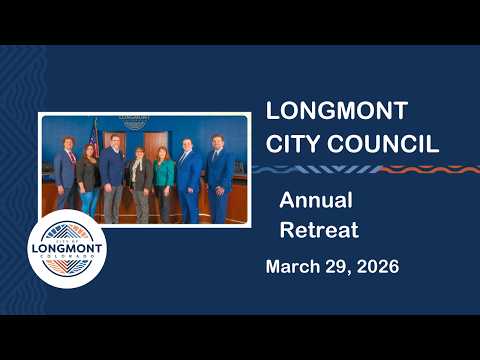
At a weekend retreat, Longmont councilors agreed to condense the city vision into a shorter, more actionable statement and prioritized near-term actions including for‑sale housing, human‑services funding strategy and foundational steps toward universal child care and transit-oriented growth.
Facilitator: The retreat began with staff reading the city’s existing vision, which includes lines about Longmont being “the world’s greatest village,” supporting children and older adults, and pursuing 100% renewable power. Facilitator asked the council whether the wording still “feels right” and urged them to separate the aspirational statement from implementation steps.
Council members debated whether the vision was too poetic or too prescriptive. Several members said the language should be simpler and more inclusive of people of all ages; others urged explicit reference to equity and innovation. “We should be careful not to conflate the vision with the theory of action,” one member said, urging a short elevator pitch paired with a separate theory-of-action document.
After group discussion, members completed a short exercise — each writing three words or short phrases to describe Longmont’s future. Submissions included resilience, affordability, innovation, and community connection. Staff collected those inputs and will produce three candidate, plain‑language vision statements for council review.
The retreat’s interactive exercise asked councilors to place ‘action’ stickies on a matrix (easy–hard vs. traditional–innovative). Near‑term, executable priorities that drew broad interest were efforts to increase for‑sale housing and to reassess human‑services funding so limited dollars can achieve higher impact. Members also identified longer‑term, aspirational items — universal child care, a mixed‑use innovation zone around the sugar mill area, and improved regional transit connectivity — that would require multi‑jurisdictional partners or ballot measures.
Several councilors volunteered to take ownership of specific follow‑up tasks. Staff was directed to compile the retreat outputs into a short list of priorities, propose measurable near‑term actions the council could vote on within 90–180 days, and return with options for sequencing and funding.
Council next steps: staff will draft concise vision options, assemble the prioritized action list, and propose a short workplan for the next 90–180 days. No formal votes or ordinances were taken at the retreat.