Get Full Government Meeting Transcripts, Videos, & Alerts Forever!
Get email alerts on the Charter Revision topic
No spam. Unsubscribe anytime.
Panama City charter-review panel narrows police language, debates independent comptroller and strips planning‑board text
Summary
At a March meeting, Panama City’s Charter Review Advisory Board moved to clarify police/fire leadership language, debated creating an independent controller/CFO versus keeping financial duties under the city manager, and voted to remove planning‑board provisions from the charter while retaining advisory‑board language. Staff will draft revised text for the next meeting.
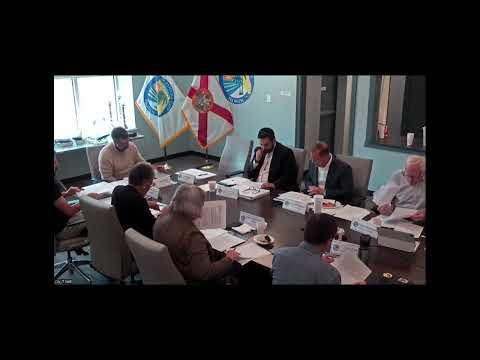
The Panama City Charter Review Advisory Board met to consider a package of proposed charter edits and to give staff direction on several high‑profile items, including how the charter should describe police and fire leadership, whether to create a separate controller or comptroller role for fiscal oversight, and whether the charter should retain specific planning‑board language.
Board members began with staff reports on background research. Staff said they had compiled roughly 35 examples from Florida showing a range of approaches to elected‑official pay and related benefits, including examples where mayor and council pay are tied by formula to county commissioner salaries. That research was distributed to members in advance to inform a later compensation discussion.
Why it matters: the board is balancing clarity for the public with flexibility for future administrations. On police and fire language, members questioned whether the charter should require a named "chief of police" or instead retain broader wording such as a "lead person" designated by the city manager. Proponents of naming a chief argued it provides clearer public expectations; opponents warned that explicit language could limit future options such as contracting with the sheriff’s office.
On the planning board, the board heard a statutory primer from guest attorney Mike Burke. Burke explained that Florida law requires a local planning agency and that many planning matters move from a planning board recommendation to the city commission for ordinance readings; by contrast, certain variances and major development orders may be decided at the planning‑board level and are appealable to circuit court. "The planning board is probably one of the more active boards," Burke told the committee, describing its role in comprehensive‑plan amendments, rezoning, and development‑order reviews.
Based on debate about duplication and future clarity, the advisory board voted on a motion to strike the planning‑board provision from the charter and to retain a separate provision preserving advisory‑board authority. Members who supported striking said state statute and ordinance already govern the planning board; those who opposed said a short charter reference helps citizens locate the city’s governance structure.
The meeting featured an extended discussion of the clerk, controller and finance functions. Several members proposed separating the statutory recordkeeping duties of the city clerk (which would remain) from a separate fiscal oversight officer (variously described as a controller, comptroller or CFO). Proponents argued an independent finance officer who could report to the commission would provide an additional check on spending and offer deeper, ongoing fiscal review than outside auditors can provide. Others said the city manager should retain operational financial accountability and warned that a charter officer who could bypass the manager risked governance confusion. Staff summarized the status quo: monthly financial memos are provided to the commission under consent and more detailed information is available on request; audits are performed by external auditors who brief elected officials and senior staff.
On taxation and revenue, staff cautioned members about changing language tied to Panama City’s grandfathered merchant (gross‑receipts) fee, which staff estimated contributes roughly $13–14 million annually. Members asked for a memo tracing the fee’s history and the potential fiscal impact of any charter change.
Other items covered included bonds and reserve‑policy context (staff said bond authorization and pledging are highly regulated and largely market‑driven), and limited discussion of recall, censure and ethics mechanisms (members noted removal remains the province of recall or gubernatorial action tied to misconduct and that ethics complaints may be referred to state authorities).
What the board directed staff to do: draft proposed replacement language for Article 17 (public utilities) modeled on broader municipal‑powers wording; draft clarified police/fire language that could read "chief of police" designated by the city manager (and the alternative more flexible phrasing); prepare charter language options that separate clerk recordkeeping duties from a controller/CFO role and outline reporting relationships; prepare a memorandum on the merchant tax history and revenue significance; and produce updated redlines for the next meeting, currently scheduled for April 23.
The meeting concluded with administrative scheduling and a motion to adjourn.