Get Full Government Meeting Transcripts, Videos, & Alerts Forever!
Get email alerts on the Urban Forest topic
No spam. Unsubscribe anytime.
Council reviews Urban Forest Master Plan, considers permit program and targeted planting ($400K/year estimate)
Summary
City staff and consultants presented Bloomington's draft Urban Forest Master Plan on March 9, reporting a 35% tree canopy, a street-tree inventory of 24,549 trees and an estimated 11,000 priority planting sites. Staff outlined program options ranging from an expanded permit approach to a full city planting program; council favored a hybrid (permit + targeted equity program) and asked staff to return with a refined draft by the end of April.
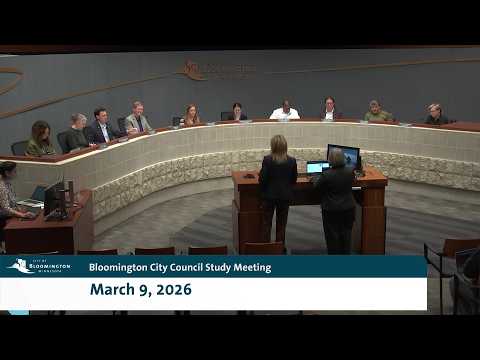
Bloomington councilmembers on March 9 reviewed a data-rich draft of the city's Urban Forest Master Plan and discussed options for expanding tree planting and proactive maintenance.
Consultants from Dav y Resource Group and city staff presented an urban-canopy assessment and a smart-tree inventory. The presentation reported an estimated citywide tree canopy of about 35% (with wide variation by neighborhood), a street-tree inventory of 24,549 trees along roughly 450 miles of streets, and field-inspection recommendations that identified about 56 trees for removal and another 256 for pruning.
Staff and consultants highlighted priority planting areas identified via heat-map analysis that factor in heat-island reduction, stormwater capture and social equity. They said their analysis indicates roughly 45,000 potential planting sites across the city, of which staff estimate about 11,000 would be viable priority sites for an initial city-focused planting program.
On costs, staff said a targeted, city-initiated planting program focused on priority areas would require roughly $400,000 a year in new funding for planting and early maintenance. If the city chose a full citywide, multi-decade implementation scale, staff estimated program costs could approach $1 million per year.
Presenters showcased the smart-tree inventory and digital tools developed as part of the plan. "The smart-tree process captures an unprecedented amount of data," a consultant said, noting high-resolution imagery and a digital twin that can be used to prioritize proactive maintenance rather than purely reactive removals.
Council members asked detailed operational questions: how crown-size classes were defined, whether the data could identify specific safe planting locations that avoid underground utilities, long-term maintenance costs, and how to balance planting with other budget priorities. Several members urged combining resident-led permit planting with a targeted city planting program to advance equity in lower-canopy neighborhoods.
Staff flagged policy issues: tree-planting within rights of way is currently restricted except by permit, and the code has provisions dating back to the 1950s and 1970s that staff recommended aligning with current practice. Staff recommended continuing the practice of not entering private property for routine inspections or removals while improving online resources for homeowners and clarifying code language.
What happens next: staff will refine the draft plan to reflect council feedback and return with a revised draft by the end of April and with a plan for adoption later in the spring. Council did not adopt the plan on March 9 and no binding policy change was made during the study session.