Get Full Government Meeting Transcripts, Videos, & Alerts Forever!
Get email alerts on the Franchise Fees topic
No spam. Unsubscribe anytime.
Bloomington council weighs franchise-fee increases, proposes $200,000 annual fund for retaining-wall repairs
Summary
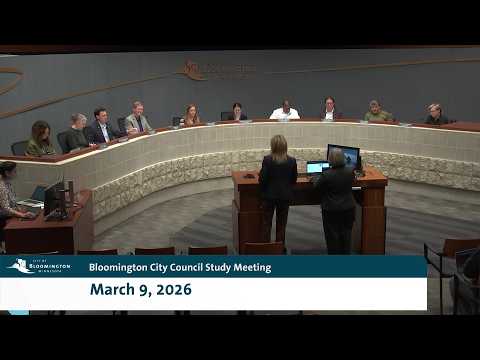
At a March 9 study session the Bloomington City Council reviewed staff's modeling of flat and consumption-based franchise-fee options and discussed adding a retaining-wall category. Staff said franchise fees generate about $8.8 million and that allocating roughly $200,000 a year to walls is feasible; no final vote was taken.
At a March 9 study session the Bloomington City Council reviewed potential changes to Bloomington's franchise-fee structure and discussed adding a dedicated retaining-wall category to the program.
Staff told the council the city currently collects about $8.8 million in franchise-fee revenue and that a flat monthly fee structure would provide stable, predictable funding for the Pavement Management Program and related projects. Staff said, under the flat-rate model presented, less than 2.5% of the franchise-fee revenue (about $200,000 annually) could be directed to retaining-wall repairs.
The proposal was described as a way to address dozens of walls in the public right-of-way that will reach the end of their useful life in coming years. "Some of these walls' replacements can be rather expensive; one example is in the $750,000 to $1 million range," staff said, urging a dedicated funding source rather than relying solely on carryover general-fund dollars.
Staff summarized the program's history and uses: franchise fees were implemented in 2015 and have been used for overlays, seal coats, trail and park construction, right-of-way trail maintenance and, beginning in 2023, sidewalks and ADA ramp work. Presenters said they have overlaid about 85 miles of streets and reconstructed nearly 9.5 miles of right-of-way trails since the franchise fees began; the city maintains roughly 340 miles of streets in total.
Council members pressed on equity and alternatives. A staff presentation noted that eliminating franchise fees and replacing the revenue through property taxes would require about a 9% increase in the tax levy to cover the same level of street and trail work. One councilmember argued that franchise fees are effectively a city choice passed through by utilities and reiterated concerns about the distributional impact on households and nonprofits.
Representatives from CenterPoint Energy and Xcel Energy briefed council on customer categories used to assign charges and on privacy limits around customer data. Xcel's representative said some large-customer-level data could not be shared because there were fewer than 15 customers in certain categories and that state data-privacy rules limit disclosure.
Council discussion leaned toward retaining a flat-rate structure for residents for the sake of predictability, while some members supported modest increases for commercial classes and agreed that including retaining walls as a funded category merited consideration. Council did not take a final vote on franchise fees at the study session; staff said next steps would include public outreach (an open house), additional briefings if council requests them, and a public hearing later in the spring before any formal ordinance change or adoption.
What happens next: staff will refine materials and return with public-engagement details and a proposed schedule; no final rate change was adopted at the March 9 study session.