Get Full Government Meeting Transcripts, Videos, & Alerts Forever!
Get email alerts on the Property Tax topic
No spam. Unsubscribe anytime.
How Spokane's property-tax levy works, what the 1% cap means and where the money goes
Summary
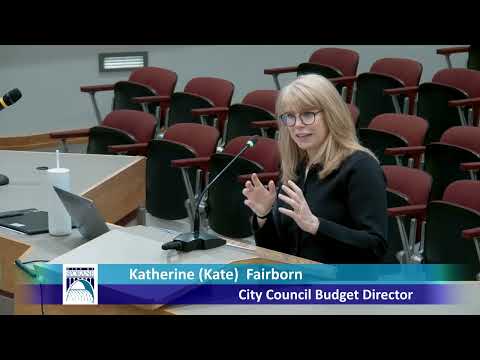
Director Kate Fairborn walked the council through the players, timing and math of property taxes, explained the statutory 1% levy‑growth limit and banking practice, and presented 2026 levy figures including a $10.15 total levy per $1,000 and a $2.59 city share per $1,000.
At a Spokane City Council study session, Director Kate Fairborn explained how property taxes are calculated, who sets assessed values, how levy limits work and what the 2026 levy numbers mean for homeowners and the city budget.
Fairborn described the principal players (the county assessor who sets assessed values; taxing districts that set budgets and levies; voters who may approve levies or bonds) and walked the council through the annual timeline: assessment work in July–September, council levy adoption in October, the first large property‑tax allocations arriving to the city in April–May, and a later influx in the fall.
"Property taxes are the largest single revenue source for the general fund," Fairborn said, and she warned that those taxes do not all flow to the city. She explained that many taxing authorities share each property tax bill, including schools, the county, libraries, streets and the city.
Fairborn gave the 2026 levy numbers used for city planning: a total levy of about $10.15 per $1,000 of assessed value; Spokane Public Schools and state school funds receive substantial shares, and the city’s portion is $2.59 per $1,000 (roughly half of which flows to the general fund to support police, courts, parks and other services). She illustrated the distribution with a worked example: an assessed value of $400,000 would produce about $4,059 in total property taxes in 2026, allocated across taxing districts as she outlined.
She also explained the statutory 1% levy‑growth limit: the city may increase its levy up to 1% above the prior‑year levy (or bank unused capacity) but that cap applies to the levy pie, not any single homeowner’s bill. Fairborn illustrated how changes in total assessed value and new construction alter individual shares even when an individual property’s assessed value is unchanged.
Council members discussed policy choices: whether to take the full 1% each year, bank capacity for future years, or direct increases into reserves. Councilman Kakkar said he had previously proposed not taking the 1% and suggested banking it to build reserves; other members discussed alternatives such as channeling growth into reserves or relying on sales‑tax growth.
Fairborn directed constituents to the county assessor’s website for parcel‑level tax breakdowns and reiterated that the city does not set assessed values; it adopts levy budgets based on assessor data and other taxing districts' demands.
The council did not take action in the session; staff will bring follow‑up materials and numbers during upcoming budget hearings and the October levy adoption window.