Get Full Government Meeting Transcripts, Videos, & Alerts Forever!
Get email alerts on the Neighborhoods Department topic
No spam. Unsubscribe anytime.
Council advances neighborhood-empowerment ordinance but withholds final vote amid friction over scope and appointments
Summary
After hours of public comment and extended amendments, the Los Angeles City Council voted to withhold final adoption of the enabling ordinance to create a Department of Neighborhood Empowerment and a board of neighborhood commissioners for one week so staff can prepare a final printed ordinance; several proposed amendments were referred to committee.
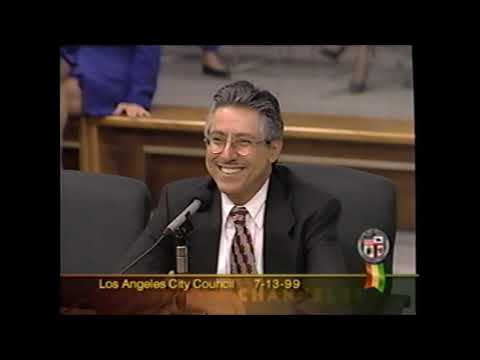
The Los Angeles City Council spent the bulk of its July 13 meeting debating an ordinance to implement the charter provision creating a Department of Neighborhood Empowerment and neighborhood councils, ultimately voting to withhold the final ordinance for one week to allow for redrafting and referral of multiple amendments to committee.
The debate followed public testimony urging bottom-up neighborhood organization. "We want neighborhood councils to organize themselves into boundaries they define, not bureaucratic districts," said Carmen Rogers of the Neighborhood Participation Project at USC during the public hearing.
Council members then turned to the ordinance's details: composition and qualifications for the board of neighborhood commissioners, duties of the new department, and whether the council should set requirements in the ordinance or leave details for rules and regulations. Council Member Fur (spoke during debate) framed his set of amendments as measures to ensure diversity on the board and to direct the department to require that neighborhood council officers reflect neighborhood interests. Several council members urged caution. "If we try to define every community of interest in ordinance, we risk excluding people," said Miss Walters, urging flexibility and delegating specifics to the regulatory process.
A recurring point of contention was the appointment process. Council Member Goldberg sought language encouraging the mayor to consider candidates with community-organizing experience and proposed a screening panel to advise the mayor; the city attorney advised that the charter limits the council's ability to prescribe qualifications the mayor must follow for the chief administrative officer. "The charter provides the general manager shall be appointed by the mayor subject to confirmation by the council," the city attorney said in response to questions.
Other amendments would have required the department to help mitigate participation barriers (child care, translation and limited transportation assistance), or to instruct the mayor to appoint a screening panel of community organizers; some council members pressed to move the more substantive, operational provisions into later rulemaking rather than the enabling ordinance.
After extended debate and several procedural motions, the council voted to adopt the committeereport language with limited amendments but withheld the final ordinance for a week so the full printed ordinance can be circulated with the agreed changes. The roll-call on the ordinance draft was recorded as 11-3 in favor of withholding for final drafting. Several other amendments were referred back to the charter implementation committee for further work.
What happens next: staff will prepare the final ordinance language reflecting the motions adopted July 13 and return it for formal action after the one-week hold. The Department of Neighborhood Empowerment, if created under the final ordinance, will have follow-on responsibilities to prepare detailed regulations and a plan for neighborhood councils before they are established.
Speakers quoted in this article are identified from the council transcript and included in the meeting speaker list.