Get Full Government Meeting Transcripts, Videos, & Alerts Forever!
Get email alerts on the Literature Translation topic
No spam. Unsubscribe anytime.
Library of Congress panel explores exile, motherhood and translation in Nobel laureate poets
Summary
Translators and scholars at the Library of Congress discussed Gabriela Mistral, Nelly Sachs and Wisława Szymborska, highlighting themes of displacement, maternal politics and the linguistic challenges of rendering distinctive Nobel-winning voices into English.
WASHINGTON — Translators and scholars convened at the Library of Congress to examine the poetry and lives of Gabriela Mistral, Nelly Sachs and Wisława Szymborska, focusing on exile, the ethics of language and the difficulties translators face bringing idiosyncratic voices into English. The program was part of the Library’s Live! At the Library series and Women’s History Month events.
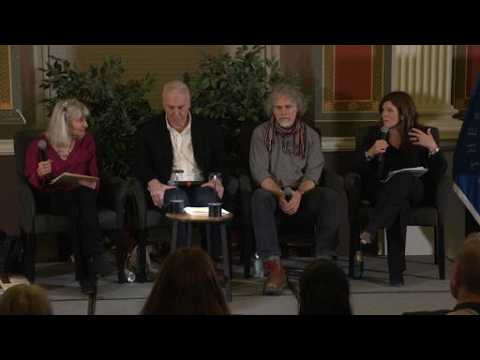
Catalina Gomez, curator in the Library’s Latin American, Caribbean and European Division, opened the evening and introduced a panel that included translator and scholar Anna Deeny Morales, translator Joshua Weiner, poet and foundation president Edward Hirsch and moderator Rosanna Warren. Michal Rusinek, president of the Wisława Szymborska Foundation and Szymborska’s former personal secretary, also attended and later read a short late notebook passage by Szymborska.
Anna Deeny Morales, who teaches at Georgetown’s Center for Latin American Studies, opened with Gabriela Mistral’s life and politics, noting Mistral’s 1945 Nobel Prize as the first awarded to a Latin American writer. Morales said Mistral’s work centers maternity and non‑biological forms of kinship and that language itself can serve as a refuge for displaced children. “When a child or any person crosses a border, two categories come into conflict: the categories of citizen and the category of humanity,” Morales said, arguing this tension runs through Mistral’s Tala and other works.
Joshua Weiner described Nelly Sachs’s trajectory from an assimilated Jewish childhood in Berlin to exile in Stockholm in 1940 — saved in part through intervention by Selma Lagerlöf — and the later, traumatic turn in Sachs’s work after she learned of the camps. Weiner discussed Sachs’s compressed, often indeterminate lines and the challenge of deciding what Sachs meant when passages resist neat interpretation. He read the poem Sachs chose for her 1966 Nobel laureate ceremony.
Edward Hirsch placed Wisława Szymborska within postwar Polish poetry and praised her ‘‘poetry of the close shave’’ — poems that test an idea to see where it leads, balancing an awareness of historical abyss with attention to small, everyday miracles. Hirsch read Szymborska’s “The Joy of Writing” to exemplify her deceptively colloquial manner and philosophical rigor.
Panelists also addressed the technical and editorial challenges of translation. Morales said Mistral’s slow, syntactically complex lines and occasional neologisms make English‑language publication difficult, while Weiner described relying on colleagues and native readers to resolve ambiguous German phrasing in Sachs. The panel emphasized iterative work: translators return to poems repeatedly to refine sound, idiom and sense.
During audience questions, panelists named poems that have stayed with them — Hirsch cited Szymborska’s “Cat in an Empty Apartment” for its restrained grief — and discussed how readers and translators grow into poems over time. Michal Rusinek closed with a brief, previously untranslated notebook passage by Szymborska that reflects on being in a country with a foreign language and learning small but significant words like “thank you.”
The program highlighted archival holdings and the Library’s role in preserving recordings and manuscripts: Morales noted the Library of Congress houses recordings of Mistral and many of her papers. The evening closed with thanks and applause and an invitation to view the related exhibit of materials from the Library’s collections.
The panel did not result in policy actions or formal decisions; it was a public program of readings and scholarly commentary.