Get Full Government Meeting Transcripts, Videos, & Alerts Forever!
Get email alerts on the Cannabis Advertising topic
No spam. Unsubscribe anytime.
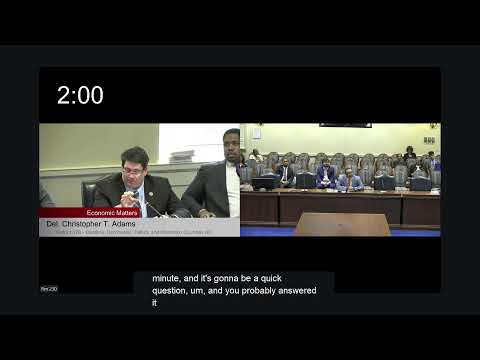
Economic Matters panel debates loosened ad limits in proposed cannabis advertising overhaul
Summary
The Economic Matters Committee heard hours of testimony on Senate Bill 594, which would specify signage caps for licensed dispensaries, allow limited business-identity claims (e.g., woman- or veteran-owned), and change how regulators assess whether ads reach under-21 audiences. Industry groups supported clarity; public-health attorneys warned the changes would increase youth exposure.
Sen. Pam Bittle, sponsor of Senate Bill 594, told the Economic Matters Committee that the measure aims to clarify and make predictable Maryland’s advertising rules for licensed cannabis businesses while balancing public-health safeguards and market realities. “Senate Bill 594 endeavors to balance public health safeguards while acknowledging the struggles both newly awarded social equity licenses and operating cannabis licenses have competing in the market saturated by unlicensed and illegal sales,” she said during her opening remarks.
The bill would set numeric limits on exterior signage (the sponsor referenced proposed caps such as 900 square inches for exterior signs and 1,200 square inches total), allow certain identity claims on signs—like “woman-owned” or “veteran-owned”—and require a statutory method for determining audience composition, including a threshold that at least 85% of the audience be over 21 for an advertisement to be permitted. It also directs the Cannabis Administration to promulgate regulations by Jan. 1, 2027 to accept attestations for event sponsorships and removes the bill’s internal definition of “therapeutic cannabis,” leaving that to the administration to define.
Industry witnesses urged the committee to approve the bill but asked for narrowly tailored clarifications. Ashley Bagwell of the Maryland Dispensary Association said Maryland already has among the strictest advertising laws in the country and described the bill as bringing “clarity” rather than loosening rules. Bagwell asked the legislature to exempt operational signs—such as “parking in rear” or “deliveries in back”—from the caps so that businesses are not penalized for basic wayfinding signage.
Representatives of social-equity licensees and growers echoed support, warning that overly rigid enforcement had blocked routine business activities. Bill Frick described receiving a noncompliance letter from the Cannabis Administration over packaging artwork that included natural images (waterfalls, palm trees) and said regulators had interpreted a “plain packaging” rule in a way he believes exceeds the statute.
The Cannabis Administration’s deputy legislative affairs chief, Selena Raleigh, said the administration supports the bill’s goals but urged the committee to retain language the bill had struck—phrases such as “or is attractive to”—because they help the agency protect youth. Raleigh described practical enforcement tools the agency would use, including design reviews and audience-composition attestations for events, and said the agency had not faced litigation over advertising to date.
Public-health legal experts opposed the bracketed deletions that would remove prohibitions on “indirect” targeting and phrases like “is attractive to.” Steven McKenny of the University of Maryland Carey School of Law said removing those protections “unnecessarily risks Maryland’s minors and disproportionately harms already overburdened communities,” citing research linking youth exposure to advertising with increased likelihood of use. George Townzen of the Legal Resource Center for Public Health Policy warned the committee the statute currently allows regulators to consider both direct and indirect targeting when evaluating advertisements and urged the committee to preserve that language.
Committee members pressed witnesses on operational details: whether temporary decorations or sponsor signage at charity events could be treated as indirect marketing to minors, how audience-composition attestations would be verified, and whether other states provide model language. Several legislators noted the difficulty of defining what advertising is “attractive to” children, offering examples such as seasonal figures or branded characters and asking regulators for concrete, enforceable definitions.
The hearing drew a broad range of support and opposition but concluded without a formal vote recorded in the transcript. The committee did not resolve all bracketed language and several members asked for follow-up meetings with stakeholders to refine definitions and enforcement tools. The committee chair closed the SB 594 hearing and moved on to other bills on the docket.
The committee is expected to continue working with the sponsor, MCA and public-health stakeholders to craft statutory language that provides both clearer boundaries for businesses and preserved protections for minors.