Get Full Government Meeting Transcripts, Videos, & Alerts Forever!
Get email alerts on the Seamless Summer Option topic
No spam. Unsubscribe anytime.
Tennessee trainers urge two-week site approvals, recap meal-pattern and monitoring rules for Seamless Summer Option
Summary
State trainers told school nutrition staff in a virtual session that the Seamless Summer Option follows National School Lunch and School Breakfast patterns, recommended submitting TMAC site approvals at least two weeks before operation so sites appear on the USDA finder, and reviewed counting, monitoring and application requirements.
State training staff walked school nutrition professionals through operational steps for the Seamless Summer Option (SSO) during a virtual session, emphasizing eligibility checks, TMAC application details and monitoring rules.
Joelene Shearer, the Senior Regional Consultant Manager leading the presentation, told participants that SSO “is an extension of those” established programs and “follows NSLP and school breakfast meal patterns,” meaning sites must keep production records, meet calorie, sodium and fat targets and claim only meals served to children for reimbursement. Shearer also stressed that a site is defined as “where the food is actually consumed by a child,” not necessarily where it is prepared.
Shearer urged staff to enter new site applications into TMAC and obtain state approval well before beginning service so families can locate sites through the USDA Site Finder. “We want to make sure that those sites are in TMAC and approved, keyword approved at least two weeks in advance before you operate,” she said, adding that the two-week window gives consultants time to review and to get the site into USDA’s public tracker.
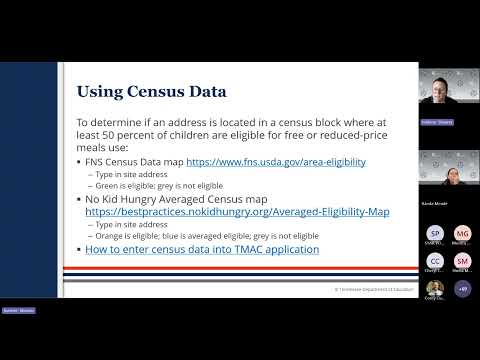
On eligibility, Shearer reviewed area-eligibility tests: a site qualifies if the attendance-area school has at least 50% of enrolled students eligible for free or reduced-price meals, or if a census block is determined to have at least 50% eligibility. She recommended using FNS census data maps and No Kid Hungry tools to verify site eligibility and noted that sites participating in the Community Eligibility Provision (CEP) must use each site’s free claiming percentage rather than a group percentage.
The training covered site types and reimbursement: open sites (first-come, first-served, children 18 and under) are typically reimbursed at the free rate when the site is area-eligible; closed enrolled sites serve identified groups and follow the age group of enrolled participants. Shearer said camps and migrant-site rules differ and that Tennessee currently has few such sites.
On recordkeeping and monitoring, Shearer said meal counts must be taken at the point of service, one reimbursable meal may be claimed per child per service, and production records are required for all meals and snacks. Shearer noted that each site must be monitored at least once during the operation period, including sites that operate for a single day, and that administrative reviews of SSO operations will generally follow school-year administrative reviews.
Shearer also explained TMAC application logistics: site IDs must be four characters (with guidance to add an “S” or an “NC” prefix where helpful for non-congregate sites), the site contact must list a street address (not a P.O. box), and period-of-operation fields and days-per-month entries roll into claims. She urged staff to complete the certification and save/submit steps in TMAC.
Shearer closed by recommending use of USDA’s SUN summer feeding logo and other outreach tools and said follow-up materials — including a vegetable-subgroup list — would be distributed after the session.
The session included audience questions about mixed congregate/non-congregate operations, TMAC naming conventions and monitoring during inclement weather; several items were left for follow-up with leadership. The trainers said a separate session next week will dive deeper into rural non-congregate and bulk-meal issues.