Get Full Government Meeting Transcripts, Videos, & Alerts Forever!
Get email alerts on the Airport Finance topic
No spam. Unsubscribe anytime.
Mesa staff propose landing fees, rent increases at Falcon Field to close $2 million shortfall
Summary
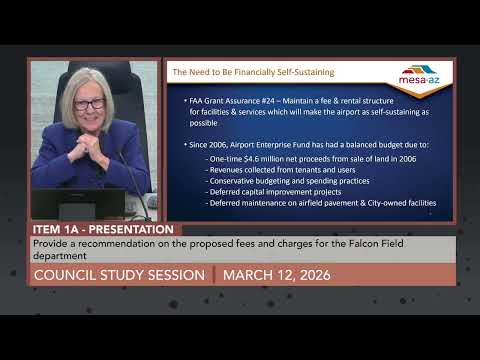
City staff told the Mesa City Council a combination of a new landing fee, higher hangar and tie-down rents and a 15% avgas (fuel flowage) fee increase are proposed to address an estimated $2.0 million annual shortfall in Falcon Field’s airfield cost center and to avoid deferred maintenance becoming reconstruction-level work.
Mesa City Manager Sam Schults and Falcon Field staff presented the council a plan on March 12 to raise several airport charges — including a proposed landing fee — to make Falcon Field Airport’s cost centers financially self-sustaining.
Karin (Falcon Field staff) told the council the airfield cost center faces about $2.4 million in annual costs and currently generates roughly $374,000 in non‑grant revenue (about $340,000 from avgas fuel flowage fees plus other small sources), leaving an approximate $2.0 million shortfall. “These fees are not being proposed to reduce noise or flight traffic, discriminate against a specific user, or favor one user over another similarly situated user,” Karin said, adding that FAA policy limits how airports may set rates.
Why it matters: staff said inflation and rising construction and pavement costs since about 2021 forced the airport to defer routine maintenance on ramps and city‑owned hangars. Deferred crack‑fill and seal‑coat work, if postponed long enough, can lead to full reconstruction that is far more expensive. Karin said many city‑owned hangars built in the 1980s and 1990s show oxidized paint and exposed metal and estimated repainting and hangar repairs will cost about $2 million.
What staff recommended: to close the gap without relying on the general fund, staff proposed a mix of increases across the airport’s three cost centers. The recommendation presented March 12 included a 10% increase in city‑owned hangar rental rates, a 23% increase for open tie‑down fees and an 11% increase for covered tie‑down fees. For avgas (fuel flowage) staff recommended raising the fee by 15%. To address remaining shortfalls in the airfield cost center, staff proposed adopting a landing fee schedule with specified exemptions.
Landing‑fee design and exemptions: staff described a structure intended to spread costs across users while complying with FAA requirements that fees be fair, reasonable and not unjustly discriminatory. Proposed exemptions would include: the first 10 landings per month for each aircraft based at Falcon Field (based aircraft are those stored at the airport more than six months; staff reported about 877 based aircraft), rotorcraft and eVTOLs when using exclusive‑use ramps, aircraft declaring FAA emergency alerts, government aircraft and flights supporting public safety (search and rescue, disaster response, infrastructure protection), production flight testing by based tenants, city‑sponsored special‑event flights and medical flights transporting patients or organs.
FAA review and legal compliance: the city sought early feedback from the FAA. Jill Owens, outside legal counsel with Snell & Wilmer, said staff discussed the proposal with FAA Phoenix District and Western Region compliance staff. “The FAA’s requirements are that fees be fair and reasonable and not unjustly discriminatory,” Owens said. She reported the FAA did not raise substantive objections during preliminary conversations but would make a final determination only if a formal complaint were filed.
Operational questions: council members pressed staff about competitiveness and whether higher landing or fuel fees would push itinerant pilots to other regional airports such as Chandler, Deer Valley or Mesa Gateway. Karin said staff considered that tradeoff and recommended gradual increases so fixed‑base operators (FBOs) can remain competitive. For fee administration, staff said the city would issue an RFP to hire a third‑party vendor to detect landings, invoice users and manage collections because the city lacks that specialized software and staffing.
Outreach and schedule: staff said they conducted 15 virtual outreach meetings with aeronautical users and tenants, posted materials online and held monthly "Ask the Airport" sessions; some changes to the original proposal were made based on tenant feedback. Councilmember Goforth moved to advance the item for council consideration; the item is scheduled for a council vote on March 23, 2026, and staff said fees would be effective May 1 if approved.
Next steps and caveats: staff emphasized the proposal is meant to keep the airport safe and operational without general‑fund subsidies and that fees will be reviewed annually. The FAA can review and rule on any complaint about rate reasonableness or discrimination, and staff said they are prepared to defend their analysis and rate base.
Ending: the council did not take a final vote on the landing‑fee proposal at the March 12 study session; it was scheduled for the March 23 council meeting for consideration.