Get Full Government Meeting Transcripts, Videos, & Alerts Forever!
Get email alerts on the Class Size topic
No spam. Unsubscribe anytime.
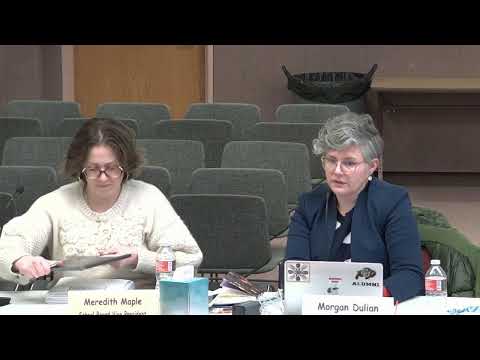
Board debates class‑size cuts, music and counselors as priorities for FY27
Summary
Board members clashed over the trade-offs between lowering pupil‑teacher ratios, restoring music programs and adding counselors or tutors; after an exercise they tentatively favored some middle‑school PTR reduction, limited music restorations and additional support staff pending further review.
Board members spent much of the work session weighing competing priorities: smaller class sizes (PTR), reinstating music programming, restoring counselors and directing more classroom tutors or school behavior support technicians (SPSTs).
A number of members argued that smaller classes are a competitive advantage relative to charter schools. Mr. Doran pressed for parity across grade levels and asked the board to consider reducing middle-school PTR to 27 and further lowering elementary PTR for parity. “To create a competitive space for our neighborhood elementary schools... I would like to level that playing field and I'm going to advocate pretty hard to lower our elementary PTR,” Miss Julian said.
Others urged caution: reducing PTR requires hiring additional certified teachers amid a tight labor market. Several board members proposed alternatives that would expand noncertified supports instead of pushing PTR beyond the recommended level: additional classroom tutors, school behavior‑support technicians, and more ELP (extended-learning program) teachers. Administration advised that adding tutors and SPSTs can sometimes yield faster hires and targeted intervention capacity than immediately hiring large numbers of certified teachers.
On music, staff proposed a model that would restore eight music FTE in total but split older plans into four elementary and four secondary positions; after discussion the board worked toward a compromise that placed four elementary FTE and added two secondary positions in the scenario exercise. “If we could lower PTR plus add some of these sticky components back to our neighborhood schools... that's something I would like to offer families,” Dr. Miner said.
By the end of the session’s balancing-act exercise the board tentatively coalesced around several items to pursue further: a middle-school PTR target of 27, four elementary instrumental music positions (with secondary positions added in a smaller number), and a modest set of additional classroom tutors and SPSTs (the group tested five tutors and five SPSTs as one scenario). Members left many details — exact FTE counts, school allocations and hiring feasibility — for follow-up work and final votes.
Next steps: staff will produce costed scenarios showing equivalents (e.g., one PTR reduction vs. multiple tutors/SPSTs), clarify which schools would be prioritized, and return with options at the next budget meetings.