Get Full Government Meeting Transcripts, Videos, & Alerts Forever!
Get email alerts on the Academic Policy topic
No spam. Unsubscribe anytime.
Board questions pace of common course numbering and seeks clearer intersegmental commitments
Summary
Board members pressed chancellor’s staff about progress on AB2011 common course numbering, intersegmental articulation with CSU/UC, and use of AI to scale course alignment; faculty warned the work is labor-intensive and requires phased tech and template supports.
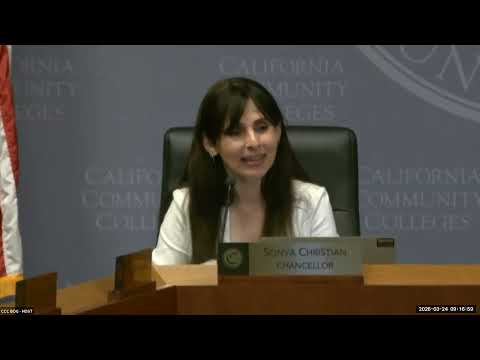
The California Community Colleges Board of Governors pressed staff on March 24 about how quickly the system can deliver common course numbering and related articulation with the University of California and California State University systems.
At the board’s meeting, Vice Chancellor staff described a phased implementation that begins with high‑enrollment general-education and transfer courses, adding that roughly 500 courses could be included in the program and that the system is “at the very beginning” of building the infrastructure. Board members and trustees repeatedly asked for concrete timelines and metrics and expressed concern about multi‑college districts where courses still do not articulate consistently among sister campuses.
Board member Tom Epstein and others asked whether AI could accelerate identification and mapping of courses. Staff replied that AI work groups are assisting in identifying candidate courses and accelerating review, but cautioned that faculty review, intersegmental articulation, and local curriculum committee approvals remain essential steps. A faculty representative said faculty work is “like a legislative process” that requires iterative committee review and local curricular control — and that adjunct faculty and multi‑college district dynamics make the last mile complex.
Several governors emphasized the policy goal that common numbering should improve credit mobility for students who attend multiple community colleges or transfer to four‑year institutions, but multiple speakers warned that if the numbering is not implemented together with intersegmental articulation the benefits will be uneven. One board member described cases where identical course content was not accepted by a neighboring college or by a CSU campus, and urged staff to prioritize a systemwide articulation mechanism rather than piecemeal course-by-course reviews.
Chancellor’s office staff said the effort is aligned with AB2011 and with intersegmental partners, and that the office is delaying later implementation phases until articulation processes with CSU and UC are formalized to avoid uneven outcomes. The board asked staff to return with clearer milestones and a plan showing how templates, AI-assisted review, and faculty governance will be coordinated so that students see predictable transfer and articulation outcomes.
Next steps: staff will continue phased implementation, increase intersegmental coordination and report more detailed timelines and measures of progress back to the board.