Get Full Government Meeting Transcripts, Videos, & Alerts Forever!
Get email alerts on the Conservation Easements topic
No spam. Unsubscribe anytime.
SAHC’s Jess Laggis briefs Buncombe County on conservation easements, funding and long due-diligence process
Summary
Jess Laggis of the Southern Appalachian Highlands Conservancy explained how conservation easements work, funding options (federal NRCS, state NCDA, private donors), the multi-year due-diligence required for perpetual easements, and stewardship responsibilities. County and partner updates followed.
Jess Laggis, who leads farmland-protection work at the Southern Appalachian Highlands Conservancy, told Buncombe County meeting participants that conservation easements are voluntary, recorded deed restrictions that permanently limit subdivision and development rights while leaving ownership with the landowner.
"A conservation easement is a voluntary legal agreement. It goes on record at the county register of deeds," Laggis said, explaining that easements are typically perpetual for her nonprofit and that easements can preserve habitat, water quality and working farmland.
Laggis walked the group through how easement value is calculated: appraisers establish a "before" (fee-simple) and "after" value, and the easement value is the difference. She summarized common funding mixes and what landowners can expect: federal NRCS agricultural easement programs can cover up to 75% of easement value; state funding through the North Carolina Department of Agriculture (NCDA/ADFP) typically pays about 50%; privately raised funds often cover roughly 25%.
She cautioned that transactions are time-consuming and require extensive due diligence. "We typically ask for two to three years for a due-diligence period on a conservation easement," Laggis said, noting the steps funders require: a survey, title review (often a multi-decade lookback for titles), a Phase I environmental site assessment, appraisal when money is exchanged, agricultural or forest-management plans where applicable, and baseline documentation for future monitoring.
Laggis described stewardship and monitoring responsibilities after closing. The land-trust stewardship team produces a baseline documentation report at closing and conducts annual monitoring to check for potential violations. She noted examples of common problems—neighbor encroachments, unauthorized building, and, in one example she cited, a timber theft that required litigation.
Board members asked practical questions about reassessments, how easements affect marketability, and whether conservation easements are public records. Laggis said easements can be found by searching the county register of deeds for grantees such as the land trust or the soil-and-water conservation district.
The presentation also addressed public-access questions. Laggis said trail easements exist but that whether a trail can be permitted depends on the landowner and on prior restrictions. "Some funders, for example NCDA, will not allow public-access easements through land they have funded," she said.
Following the presentation, land-conservation partners provided brief updates. Riverlink reported that construction documents had arrived for a Gateway Park parcel adjacent to Riverside Drive and that a Beacon Park stream-restoration grant application was pending. SAHC noted several project closings, including Devereux V, and ongoing work to secure county funding for other projects.
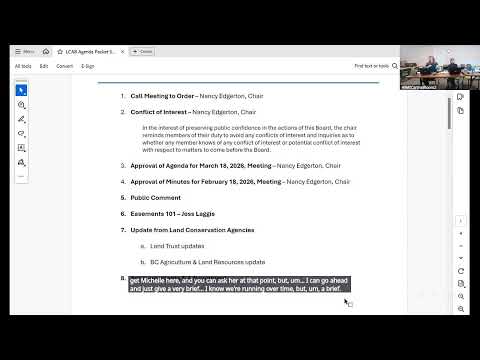
Procedural items at the start and end of the meeting included approval of the agenda and the February 18 minutes by voice vote, and a motion to adjourn that was carried by voice vote. The chair opened and closed the meeting; the record does not include a roll-call vote tally for those motions.
Next steps noted by participants included continued project-specific coordination with funding agencies and a planned farmland-conservation community meeting in November to discuss local priorities and outreach. The meeting ended after the adjournment vote.