Get Full Government Meeting Transcripts, Videos, & Alerts Forever!
Get email alerts on the Forestry Practices topic
No spam. Unsubscribe anytime.
San Miguel County drafts new forestry‑practice rules; staff to streamline wildfire mitigation for certified nonprofits
Summary
County planning staff proposed replacing old logging rules with a new forestry‑practices article that focuses review on surface disturbance, road impacts and stream crossings. Stakeholders urged fast, low‑cost pathways for wildfire mitigation and recommended a general permit or activity‑notice option for certified organizations.
San Miguel County — Planning staff on Thursday presented a draft land‑use code article to replace decades‑old logging rules with forestry‑practice regulations intended to prioritize forest health and enable wildfire mitigation while protecting water and roads.
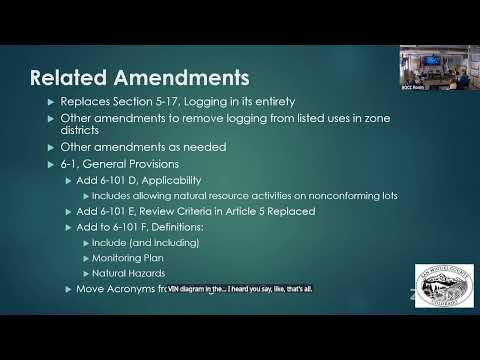
K Simson, the county planning director, said the old approach benchmarked activity by board feet and zone, a metric that grew out of commercial logging eras. The proposed article would instead focus on the area of site disturbance, road construction and designs for stream crossings and reclamation, and would split reviews into administrative permits for lower‑impact work and two‑step review for larger, landscape‑scale projects.
Siting and process: The draft would allow minor forestry practices under objective administrative standards and would make small‑scale maintenance activities (staff suggested less than a half‑acre) permitted by right; major forestry practices would require a two‑step review (planning commission followed by the Board). The draft provides an activity‑notice pathway for state or federal agency projects so the county can track impacts without duplicating federal NEPA review.
Nonprofit mitigation and timing concerns: West Region Wildfire Council staff explained the operational reality for implementing mitigation: site visit, design and contracting, and implementation — a sequence that often takes about 18 months because of seasonal limits and grant timelines. ‘‘All our work is according to the Colorado State Forest Service best practice,’’ said Tim Pinow of the West Region Wildfire Council, urging that county rules not add permitting costs or administrative delays that would slow mitigation work.
Commissioners and nonprofit partners urged staff to develop an expedited path for certified mitigation organizations. Staff agreed to explore a general permit or an activity‑notice exemption for verified entities and to add objective standards to make administrative approvals faster and less costly for small, low‑impact projects.
Operational details and public safety: The draft addresses roads (including whether new roads will be reclaimed), stream crossings and restoration plans, and it flags helicopter or steep‑slope operations for special attention and notification. Several speakers asked for clear distance and buffer rules around streams and wetlands and for notification to sheriff and road authorities when helicopter operations or large corridor work is planned.
What’s next: Staff said the forestry article will be revised to clarify definitions (for example, ‘‘surface disturbance’’ and exclusions such as normal property maintenance), to refine thresholds for minor vs. major review, and to draft a proposed general‑permit or certification path for trusted mitigation partners. Staff indicated they will continue stakeholder meetings and return a revised draft in time to coordinate with forthcoming oil, gas and geothermal code items.
— Reporting based on the March 26, 2026 San Miguel County joint work session transcript.