Get Full Government Meeting Transcripts, Videos, & Alerts Forever!
Get email alerts on the Municipal Liability topic
No spam. Unsubscribe anytime.
Michigan Supreme Court hears challenge over whether homeowners may sue townships under Miss Dig cross-reference
Summary
The Michigan Supreme Court heard arguments in Brian Zazula v. Independence Township over whether subsection 7 of the Governmental Tort Liability Act cross-references the Miss Dig Act or creates an exclusive remedy that bars homeowners from suing municipalities; justices queried whether the statute's 'may' language is permissive or constraining.
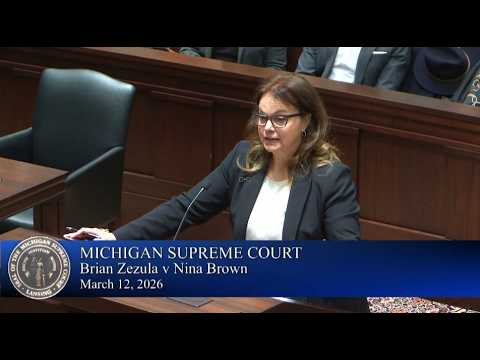
The Michigan Supreme Court heard oral argument in Brian Zazula v. Independence Township, a dispute over whether homeowners may bring civil claims against municipalities under a cross-referenced provision of the Governmental Tort Liability Act and the Miss Dig Act.
Plaintiff counsel Daniel Groves said Brian Zazula suffered roughly $130,000 in damage and urged the court not to resolve the merits before the plaintiff had the opportunity for discovery and to plead the alleged sewage-disposal-system claim. "I could get into the human aspect of how Mr. Zazula incurred $130,000 worth of damage and there's nothing he did wrong," Groves said during argument, pressing that whether a homeowner qualifies as a "facility owner" under the Miss Dig Act is a question of fact.
Counsel for Independence Township, Margaret Deler, framed the case as a statutory-interpretation dispute limited to two questions the Court granted leave to consider: whether MCL 691.1407(7) of the Governmental Tort Liability Act is properly read as a cross-reference to the Miss Dig Act rather than a free-standing exception to governmental immunity, and whether the trial court erred in allowing the plaintiff to amend his complaint to add a sewage-disposal-system exception claim (cited in the argument as MCL 691.1417). Deler argued the legislature intended a limited, structured path for liability under the Miss Dig Act and that the GTLA's longstanding grant of immunity should not be read to swallow that structure.
Appal Cal Excavating Company's counsel, Michael Schmidt, pressed that the Miss Dig Act intentionally redefined "person" to include governmental agencies and that the statute therefore supplies a path for civil fines and damages when government entities fail to comply with marking and related duties. Schmidt emphasized textual and historical points about the Act’s drafting and told the Court that municipalities can face graduated fines, repair costs and other remedies under the statutory scheme.
A recurring point in the argument concerned the statute's use of the word "may." Several justices asked whether the permissive "may" in the Miss Dig provisions should be read narrowly — as creating the only available route to relief against a governmental agency — or as one non‑exclusive, permissive alternative alongside other remedies. Schmidt summarized a frequently cited principle in Michigan jurisprudence: "May means may and shall mean shall," urging that the permissive term be read as permissive rather than as an exclusive bar.
Justices also pressed procedural questions: the trial court allowed a third amended complaint and indicated the failure to mark might be treated as a "defect," but the case reached the Supreme Court on interlocutory review after motions for summary disposition and appeals. Counsel debated whether the amendment was futile and whether the lower courts and trial record needed further fact-finding or discovery before the Court resolved the statutory questions.
The argument included factual allegations about marking practices. Schmidt told the Court that, according to the plaintiff's evidence and the township's own diagram, a sanitary-lead stub and an existing main on the south side of the street should have been marked and were not. Counsel for the defense contended some remedial avenues — including filing a complaint with the Michigan Public Service Commission — were available to an injured homeowner who qualifies as a facility owner under the statute.
The bench heard amicus briefs and questions about precedent, including State Farm v. Corby and Zeni v. Anderson, as counsel on all sides urged either a narrow, statute-bound path for claims against governments or a broader reading that preserves other civil remedies. After rebuttal time, the Court submitted the case for decision.
The justices gave no timetable for a ruling. The case turns on textual readings of the Miss Dig Act and the Governmental Tort Liability Act, the scope of the statutory cross-reference cited by the GTLA, and whether a homeowner in these facts can be treated as a facility owner with an alternative administrative remedy or is entitled to pursue civil damages in court.