Get Full Government Meeting Transcripts, Videos, & Alerts Forever!
Get email alerts on the Committee Workplans topic
No spam. Unsubscribe anytime.
Los Altos Hills committees press wildfire readiness, pathway projects and code clarifications in two‑year work plan reviews
Summary
At a Jan. 21 special meeting, Los Altos Hills committees reported 2025 accomplishments and proposed priorities for 2026–27, spotlighting wildfire preparedness (including a proposed full‑time emergency manager and LRAD sound survey), pathway construction plans, fee studies and the need to clarify tree/view rules for annexed parcels.
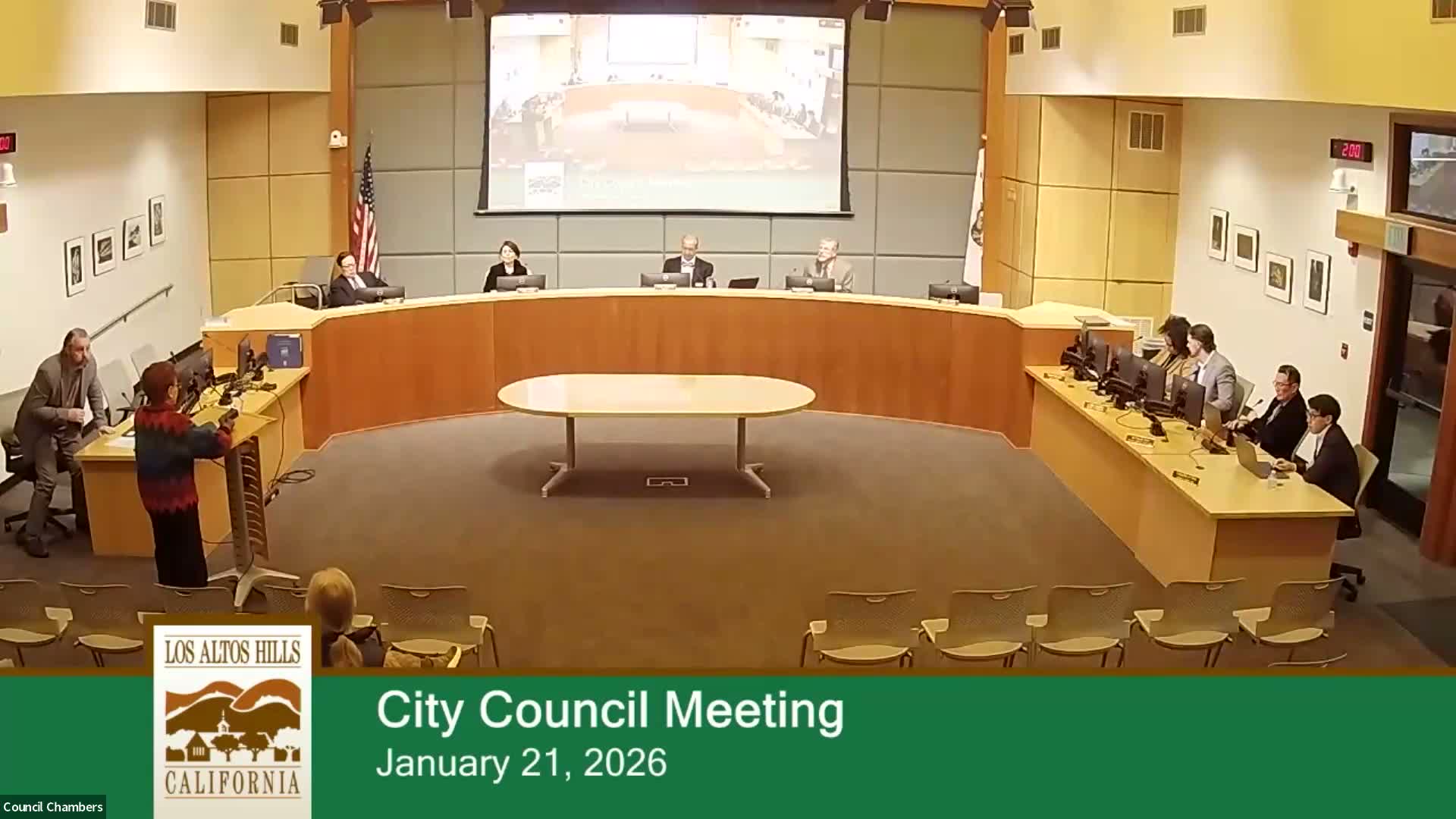
Mayor Rajeev Bateja convened the Los Altos Hills City Council special meeting on Jan. 21, 2026, to hear annual reports and proposed two‑year work plans from the town’s standing committees. Presenters emphasized wildfire preparedness, pathway projects, fee and code reviews, and outreach efforts; no formal council votes were taken.
The meeting opened with public comment from Gerda Crystal, who said her parcel — annexed into the town in 2012 — had been assured it would be maintained “on an as‑is basis,” but that inconsistent interpretation of view and tree codes has led to stress and litigation. "The lack of clarity in the codes and the failure to recognize the legal rights of the annexed areas held prior to annexation has created significant ambiguity," she said, urging council action. Councilmembers and committee chairs acknowledged the concern and noted the issue will be considered in upcoming committee discussions and on the council’s work plan.
Committees then summarized 2025 accomplishments and set priorities. Environmental Design & Protection Committee Chair Grama Singh said EDPC conducted 32 site visits, supported native‑plant installations at Town Hall and revised the Willow water‑allowance formula to lower homeowner allocations; the committee is reviewing tree and oak‑heritage rules to reconcile wildfire safety with preservation goals. "We never know when a drought is coming," she told the council, and EDPC recommended updating landscape guidance and aligning conflicting ordinance language.
Environmental Initiatives Committee Chair Anand Ranganathan highlighted the town’s reach‑code adoption, greenhouse‑gas inventory work, deployment of SolarAPP+ for permitting and ongoing electrification outreach. Ranganathan said EIC may request modest outreach funding to expand community electrification programs and is developing a dashboard to track residential electrification progress.
Emergency Preparedness & Response Vice Chair Dave Stewart urged the town to prioritize a full‑time emergency manager to coordinate evacuation planning, interagency work and the many state and county requirements EPRC cannot complete as volunteers. "If we have one goal we'd like to see adopted from the council, this is it — that we need to have a full time emergency manager," Stewart said. He also reported progress on radio‑repeater upgrades and a budgeted $30,000 LRAD (long‑range acoustic device) sound‑survey to identify optimal device locations for areas with limited cell or internet service.
Finance & Investment Committee Chair Alan Epstein described a cap and building fee study as a top FIC priority, ongoing accounting automation and a likely sewer‑rate study; Epstein urged separating routine staff tasks from nonroutine, council‑directed work when assembling the two‑year work plan. "Focus the work plan on the things that the council wishes to initiate and approve," he said.
Other committee highlights included: the History Committee’s Heritage House preservation and plans for a volunteer‑written town history; the Open Space Committee’s site reviews and bench‑donation policy work; the merged Parks, Recreation & Community Events committee reporting a highly attended town picnic and a petition drive for a town pickleball court; and the Pathways Committee outlining Magdalena and Summerhill pathway phases and ongoing GIS updates to prioritize low‑cost, high‑value segments.
The Planning Commission summarized required housing‑related work (ADU, SB9 updates and an A12 duplex/triplex exercise), requested GIS layers (waterways and ridgeline protection) to enable objective, ministerial reviews and noted staff time limits. The Technology Committee proposed a multi‑sensor fire‑detection and mitigation dashboard (camera, satellite, sensors) tied to mitigation tools such as drones and LRADs, and flagged AI, cybersecurity and broadband redundancy as continuing priorities. "What we envision is a dashboard where we can combine all of these different ways of detecting fire," said the Technology Committee chair.
The council thanked volunteers and committee chairs for the reports and said staff and council will use the committee input to develop a draft two‑year work plan for future council consideration. No formal actions or votes were recorded during the meeting; several items — including potential charter amendments, hiring a dedicated emergency manager and fee studies — were identified as next steps for staff and council review.
The meeting adjourned with committee follow‑ups and scheduling of related workshops and hearings.