Get Full Government Meeting Transcripts, Videos, & Alerts Forever!
Get email alerts on the Wildfire Landscaping topic
No spam. Unsubscribe anytime.
Local planning committee advances wildfire-resilient landscaping guidance, debates tree distances and home hardening
Summary
Los Altos Hills’ Environmental Design and Preservation Committee spent its meeting revising a draft landscaping guide to prioritize wildfire resilience, proposing numeric guidance for new plantings (discussed 5 feet from roofline, 10 feet where branches overhang) and recommending avoiding highly flammable species in new landscapes; members stressed the guide should not force removal of mature trees and linked the effort to pending ordinance updates.
The Los Altos Hills Environmental Design and Preservation Committee (EDPC) spent most of its meeting refining a draft wildfire‑resilient landscaping guide, with members prioritizing fire safety in new landscape design while seeking to avoid mandates that would require removal of mature trees.
Committee member Peter, who led the revision effort, said the meeting focused on clarifying guidance for new plantings and aligning recommendations with existing municipal and Cal FIRE guidance. “I modified it to say the top priority in designing landscaping,” he told the committee, explaining he added references to the town code, Cal FIRE defensible‑space guidance and other model documents.
The group debated numeric spacing standards for new trees and branches. One proposal under discussion would keep new trunks at least 5 feet from a roofline and require a 10‑foot clearance for overhanging branches to reduce ember transfer; members said the guide should distinguish requirements for new landscaping from treatment of existing mature trees. “We don’t want somebody to go cut down all the trees that are already existing,” a committee member said, urging the document emphasize new development rather than retroactively forcing tree removal.
Members also proposed removing detailed mulch prescriptions and instead include higher‑level guidance: avoid highly flammable plants in zones closest to structures, provide spacing in intermediate zones and recommend reference materials for slope‑specific requirements. The committee discussed a short list of plant genera to avoid in new landscaping and adding a plant list for recommended species in a later version.
The draft will keep practical references: HIZ evaluations and links to authoritative pages (Cal FIRE, Marin County, Santa Monica Mountains defensible‑space guidance) but committee members recommended listing document titles with links so users can locate resources if URLs change. Several members urged including discussion of “home hardening” alongside landscaping, describing the two as complementary steps to reduce wildfire risk.
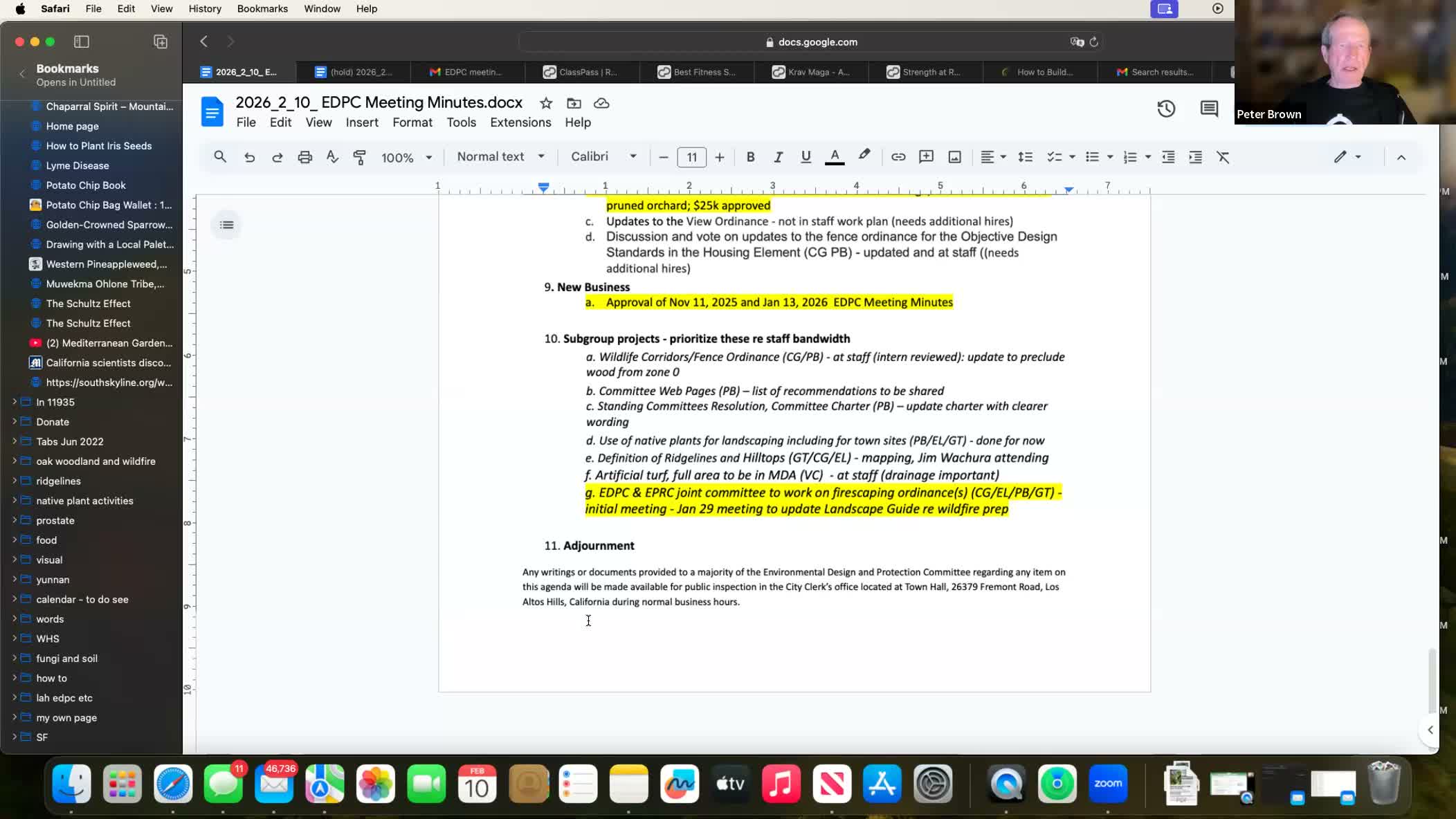
The committee agreed to consolidate comments and publish a revised “landscaping guide 2.2” for review; members also noted the town plans to update related ordinances, and EDPC recommended timing the guide release with those municipal code updates. The committee asked Peter and other volunteers to circulate edits and to help update the plant list before the next release.
Next steps: EDPC will produce version 2.2 incorporating today’s edits, coordinate with staff on ordinance timing, and consider inviting local fire evaluators for demonstration HIZ assessments to inform final guidance.