Get Full Government Meeting Transcripts, Videos, & Alerts Forever!
Get email alerts on the Traffic Calming topic
No spam. Unsubscribe anytime.
NDOT proposes speed cushions, striping and a 'slow safer shoulder' for Maryale Drive after engineers recorded 40 mph 85th‑percentile
Summary
NDOT presented a preliminary plan for Maryale Drive that would add three sets of speed cushions, pavement striping or a one‑side 'slow safer shoulder' and radar signage after engineers found an 85th‑percentile speed near 40 mph on the 25 mph residential street; adjacent-property balloting will follow final design.
The Nashville Department of Transportation (NDOT) on Monday presented a preliminary traffic‑calming plan for Maryale Drive after consultants measured an 85th‑percentile speed of about 40 miles per hour on a street posted at 25 mph, NDOT consultant Amy Burch said.
Burch said NDOT’s proposal would place three sets of modular speed cushions along the project limits between Old Hickory Boulevard and Traon Drive, add pavement striping or a single‑side “slow safer shoulder” where engineering allows, and pair vertical devices with warning signage and radar feedback signs. “We measured the 85th‑percentile speed on Maryale to be 40 miles an hour,” Burch said. “The daily volumes are just under a thousand cars a day.”
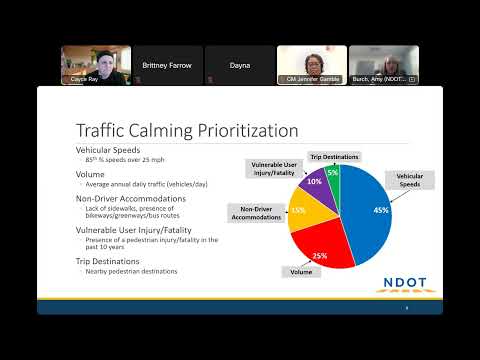
The proposal follows NDOT’s neighborhood traffic‑calming selection process, which chose Maryale as one of 25 streets in the most recent round from more than 700 applications. NDOT said the program prioritizes five factors: the 85th‑percentile speed (45% of the score), 24‑hour volume (25%), non‑driver accommodations such as sidewalks or nearby transit (15%), a 10‑year crash history (10%), and proximity to destinations such as schools or parks (5%).
Why it matters
Residents told NDOT the street is used as a school and neighborhood cut‑through and expressed safety concerns for children, pedestrians and older adults. “I walk and it always feels a little dangerous,” resident Britney said. “I’d love to see sidewalks in the whole neighborhood.”
Design and effectiveness
Burch described speed cushions as modular rubber devices placed in a series so emergency vehicles can straddle the gaps while passenger cars cross the cushions; she said the devices are typically 3 inches high and spaced 300–600 feet apart, with the Maryale concept showing roughly 360‑foot spacing. Citing NDOT before‑and‑after studies, she said average speeds on treated streets fell from about 31 to 22 mph and 85th‑percentile speeds fell from 37 to 25 mph.
Residents’ concerns and alternatives
Several residents supported cushions plus additional pavement markings or a slow‑safer‑shoulder treatment where space permits. Resident Casey cautioned that single‑lane pinch points could worsen afternoon school‑traffic backups, saying school dismissal already causes long queues near the Old Hickory intersection and that one‑way pinch treatments might create circulation problems during peak periods.
NDOT’s process and next steps
NDOT said the project is funded and would move to a mailed ballot after final design. Balloting will be limited to properties that abut the affected right‑of‑way — NDOT identified 17 eligible voting properties (residences, churches and schools). Residents will receive unique‑ID postcards and have a six‑week window to vote online or by phone; a two‑thirds (66%) favorable vote is required to proceed to construction. “If 66% of those that vote vote in favor of the project, then it would move into the construction queue,” Burch said.
NDOT will post detailed, zoomed‑in plans on the project’s Engage Nashville page showing cushion locations and measurements from driveways, and it offered to schedule a follow‑up meeting in about a month to present the refined design. NDOT also advised residents to file safety requests through Metro’s 311/hub service for issues outside the traffic‑calming program’s authority.
Old Hickory Boulevard and state roads
Several participants pressed for attention to Old Hickory Boulevard, a state‑maintained artery that some said contributes to dangerous cut‑through speeds on adjacent neighborhood streets. Meeting participants noted recent outreach to state legislators and urged coordination with the Tennessee Department of Transportation (TDOT). NDOT staff said they can coordinate and encouraged constituents to contact their state representatives.
What happens next
NDOT will finalize the design, post updated plans to the Engage Nashville Maryale Drive page, and notify the neighborhood about either a follow‑up meeting or the start of the six‑week ballot. If the ballot meets the 66% approval threshold among eligible properties, the project will enter NDOT’s construction queue; if not, NDOT will revisit the plan with residents.