Get Full Government Meeting Transcripts, Videos, & Alerts Forever!
Get email alerts on the Hr1 Impact topic
No spam. Unsubscribe anytime.
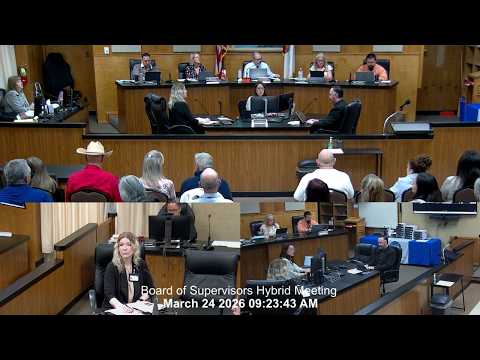
Lake County supervisors hear HR1 impact estimates; staff warn 2,000–2,500 could lose medical coverage
Summary
County social services staff told the Board of Supervisors that provisions tied to federal HR1 could put an estimated 2,000–2,500 Lake County residents at risk of losing medical coverage and 1,000–1,200 at risk of losing CalFresh; the board discussed sending letters to a county coalition seeking state budget mitigation and asked for fiscal follow‑up after the governor's May revision.
Lake County’s Board of Supervisors received an update on federal HR1 and its likely local effects on benefits programs, with Social Services Director Rachel Dolman Parson saying the county faces potential large reductions in enrollment and added administrative costs.
"Fifty percent of Lake County’s residents receive medical," Rachel Dolman Parson told the board, adding that roughly 25% receive CalFresh. She estimated that between 2,000 and 2,500 people are at risk of losing medical coverage and that 1,000 to 1,200 could lose CalFresh benefits if HR1 provisions are implemented without additional state funding or mitigation.
The board heard the update from Jeff Neil, who said the legislative session has begun in earnest and that most bills will be clearer after amendments and committee hearings in April. Neil said the appropriations committee typically produces dollar estimates for state and sometimes local cost impacts; this year, appropriations action will coincide with the governor's May budget revision on May 14, which staff expect will produce more concrete cost numbers.
Why this matters: Local social‑safety net programs and county operations could face both higher costs and heavier workloads if the state does not fully backfill changes required by HR1. Dolman Parson told supervisors that several changes are already in motion or scheduled: work‑requirement policy implementation for able‑bodied adults without dependent children is scheduled to begin June 1; several major redetermination and administrative changes will take effect in 2027, including six‑month redeterminations and other shifts the director said carry significant staff workload without guaranteed funding.
Dolman Parson described mitigation steps the department is pursuing to preserve enrollment and control costs. The department has frozen non‑emergency overtime, producing savings equivalent to about 3.5 full‑time positions, is planning to colocate some services (with a co‑location beginning April 1), and intends to launch CalFresh employment and training services in October. Staff are also exploring automated tools to speed case documentation and pursuing federal administrative claiming where possible. She cautioned that if optional services are not sufficiently funded, the county may need to consider cuts.
County associations have assembled a multi‑county budget request to seek state funding to offset HR1 impacts. Matthew Rothstein told the board that a coalition of county groups circulated a request seeking what he reported as $1.9 billion for 2026‑27 and $4.5 billion for 2027‑28 to stabilize county indigent care, workforce capacity, behavioral health, and other supports. Rothstein said those sums are intended to be minimum amounts needed to avoid "serious consequences to California communities."
Supervisors asked for and received procedural guidance about advocacy and timing. Supervisor Sabatier asked when formal fiscal estimates would be available; Neil said the most useful point will be after the appropriations committee and the governor’s May revision on May 14. Supervisor Pisk asked about a deadline for sending letters of support; Neil said SEESAC asked counties to provide letters by April 7 if possible. Supervisors agreed to return a letter for consideration at the board’s April 7 meeting so the county can signal support to the statewide coalition and the governor’s office.
No formal vote was taken on the item. The board directed staff to prepare more detailed financial impact information and a draft letter for the April 7 meeting and requested a follow‑up briefing after the governor’s May budget revision. The board opened the item for public comment; no members of the public in the room spoke.
Next steps: staff will provide more detailed cost estimates and a draft letter for the board’s April 7 meeting and a financial update after the May 14 appropriations and May revision actions.