Get Full Government Meeting Transcripts, Videos, & Alerts Forever!
Get email alerts on the Building Energy Performance Standards topic
No spam. Unsubscribe anytime.
Montgomery County committee backs amended building energy rules and unveils $68.5 million for implementation
Summary
The Transportation and Environment Committee voted to support amended BEPS regulations (executive regulation 17-23 AM) that add a 30% performance cap, revise cost-effectiveness tests and expand compliance flexibility; the Montgomery County Green Bank announced $68.5 million in federal funds to support assessments and projects.
The Montgomery County Transportation and Environment Committee voted unanimously on Jan. 30 to back amended building energy performance regulations and send the package (executive regulation 17-23 AM) on to the full council for further consideration.
Emily Curley, Building Energy Performance Program Manager at the Department of Environmental Protection, summarized the changes, saying, "So what this means is that any individual building's final performance standard is not gonna require a greater than 30% reduction from that building's baseline," a new "30% performance cap" the county added to provide an additional compliance option for buildings far from their targets.
Why it matters: the BEPS law, passed in April 2022, covers most Montgomery County buildings 25,000 square feet and larger (Curley said about 1,800 buildings, roughly 250,000,000 gross square feet). DEP told the committee that benchmarking reporting rates are high (about 95% last year) and that the amended regulations use updated 2023 benchmarking data to refine final standards for certain property types, affecting roughly 10% of covered buildings.
Key changes and compliance paths: the amendments revise site energy use intensity targets for several property types and add standards for manufacturing/industrial floor area in mixed-use buildings and ambulatory surgical centers. Building owners still have two compliance options: meet the performance path (reach the normalized net site EUI at interim or final deadlines) or pursue a Building Performance Improvement Plan (BPIP). Curley outlined BPIP requirements: an ASHRAE Level 2 audit, a retrofit plan listing cost-effective measures, annual benchmarking reports tracking progress, and — for buildings that rely on a BPIP for interim compliance — implementation of all measures with a simple payback of five years or less before a final BPIP is approved. DEP also changed the cost-effectiveness test from a 25-year package to a measure-by-measure test based on each measure's useful life; certain "specially designated" buildings (including rent-stabilized multifamily, nonprofit-owned buildings, common ownership communities and some small-business-owned properties) will use a 10-year payback threshold.
Technical clarifications: DEP said it will deduct parking energy use from a building's site EUI using a Portfolio Manager data field and will exclude electricity used for EV charging (via submetering or Portfolio Manager estimates). Stan Edwards, the DEP chief leading the implementation work, told the committee that auditor assumptions (first cost, annual energy savings and useful life) will follow industry standards such as ASHRAE and that detailed program guidance will be posted on DEP's BEPS website.
Financing and implementation support: Stephen Morrell, CEO of the Montgomery County Green Bank, told the committee that federal grant funds have been deposited and that the Green Bank had "procured 68 and a half million dollars out of this grant program" to support a BEPS readiness and implementation program. Morrell described a strategy that uses the grant to create a revolving pool and to cash-collateralize demonstration bond issuances to leverage additional capital later. The Green Bank plans to subsidize assessments and submetering where appropriate and to prioritize multifamily retrofit and electrification projects.
Equity and outreach: multiple councilmembers pressed the Green Bank to avoid "first-come, first-served" allocations and to ensure underserved neighborhoods and building types receive outreach and funding. Morrell said the bank will use formulaic assessment resources for equity emphasis areas and expand marketing and contractor engagement to reach under-resourced communities.
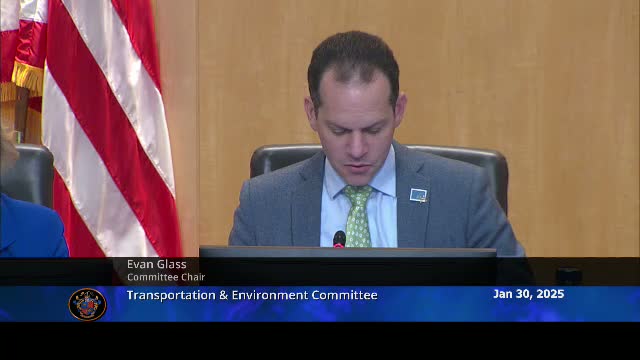
Next steps and vote: Chair Glass called for a hand vote on the amended executive regulation 17-23 AM; the chair announced the committee's support as unanimous and the item was scheduled to proceed to a full council work session on Feb. 11. No formal roll-call tally was read during the hand vote at the committee meeting.
The committee's action advances a package of regulatory changes intended to give building owners multiple, more flexible ways to comply while making county-funded technical and financial assistance available to help smaller and master-metered properties meet standards.