Get Full Government Meeting Transcripts, Videos, & Alerts Forever!
Get email alerts on the Wildfire Landscaping Guidance topic
No spam. Unsubscribe anytime.
Los Altos Hills committee refines landscaping guide to prioritize wildfire hardening and clear references
Summary
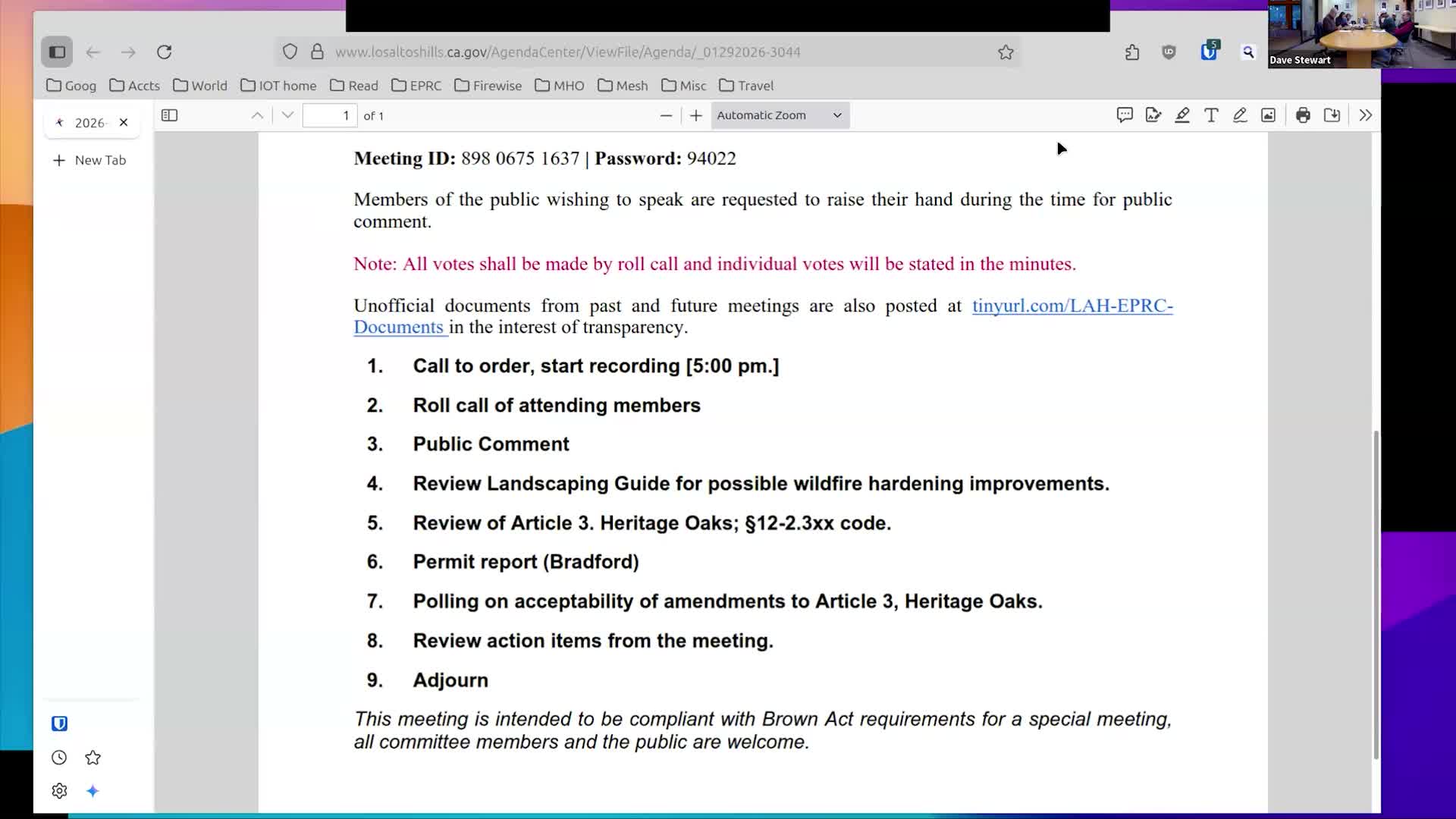
The EDPC spent two hours revising language in the town's landscaping guide to clarify defensible-space guidance, prefer authoritative links to changing standards and recommend mulch, spacing and tree-clearance practices that balance wildfire safety and habitat preservation.
The Environmental Design and Protection Committee reviewed a revised landscaping guide focused on reducing wildfire risk and agreed to tighten the document's language and references while avoiding overly prescriptive rules that might quickly go out of date. The meeting opened with members resolving technical issues and then moved into a line-by-line review of the proposed text.
Committee members debated whether to cite specific agencies such as Cal Fire or the Insurance Institute for Business & Home Safety (IBHS) and concluded that the guide should point readers to recognized safety standards and link to authoritative sources rather than echoing lengthy requirements inline. "If you keep it a little more vague, I think it's less apt to be something you have to go back and keep changing," said Paige, who advised the group on defensible-space science and local code alignment. Several members recommended adding an appendix or short reference list so readers could consult the underlying standards or pictorial guidance (for example, regional defensible-space flipbooks) without cluttering the main guidance.
The committee addressed plant and mulch guidance, removing a specific reference to "composted wood chips" after members said that product is uncommon for homeowners. Instead the group agreed to recommend inorganic mulch (for example, gravel or decomposed granite) as a noncombustible option and to allow organic wood chips outside the 0-to-5-foot zone only if compacted and no deeper than three inches. "Outside 5 to 30 (feet), our recommendation is no more than 3 inches," Paige said, explaining local field experience on chip depth and compaction.
On trees and screening, members emphasized balancing fire safety and preservation of mature oaks. The committee decided to keep the guide's core zone definitions but to use the phrase "adequately spaced" for larger plantings, paired with an asterisk linking to visual resources showing acceptable "island" planting patterns. Committee members recommended that the guide point homeowners to PG&E guidance for planting under and near power lines rather than reproducing detailed spacing tables.
The group examined enforcement and code alignment as background context but kept the landscaping guide itself framed as guidance rather than an ordinance. "This is the landscaping guide, not the code," S1 (Elizabeth), who chaired the meeting, said; members discussed that the town has incorporated parts of California's Title 24, Part 7 (WUI standards) into its local code and that guide revisions should reference those technical requirements where relevant. The committee asked staff to produce a revised draft with the clarified references, an appendix of authoritative resources and visuals for spacing and screening, and to return the draft for further review at a future meeting.
The committee did not vote on formal changes and did not take any enforcement action during the meeting. The discussion concluded with agreement on language edits, removal of the composted-wood-chips phrase, and plans to circulate an updated draft for final comment.