Get Full Government Meeting Transcripts, Videos, & Alerts Forever!
Get email alerts on the Capital Improvement Program topic
No spam. Unsubscribe anytime.
Redwood City releases FY26-27 CIP plan with $40.5M year-one program; council debates priorities and funding gaps
Summary
City staff presented a recommended FY26-27 Capital Improvement Program of $40.5 million and a five-year funding gap of roughly $427 million. Councilmembers asked about equity, sea-level rise funding, traffic-calming pilots and potential revenue strategies including municipal advisors and private fundraising.
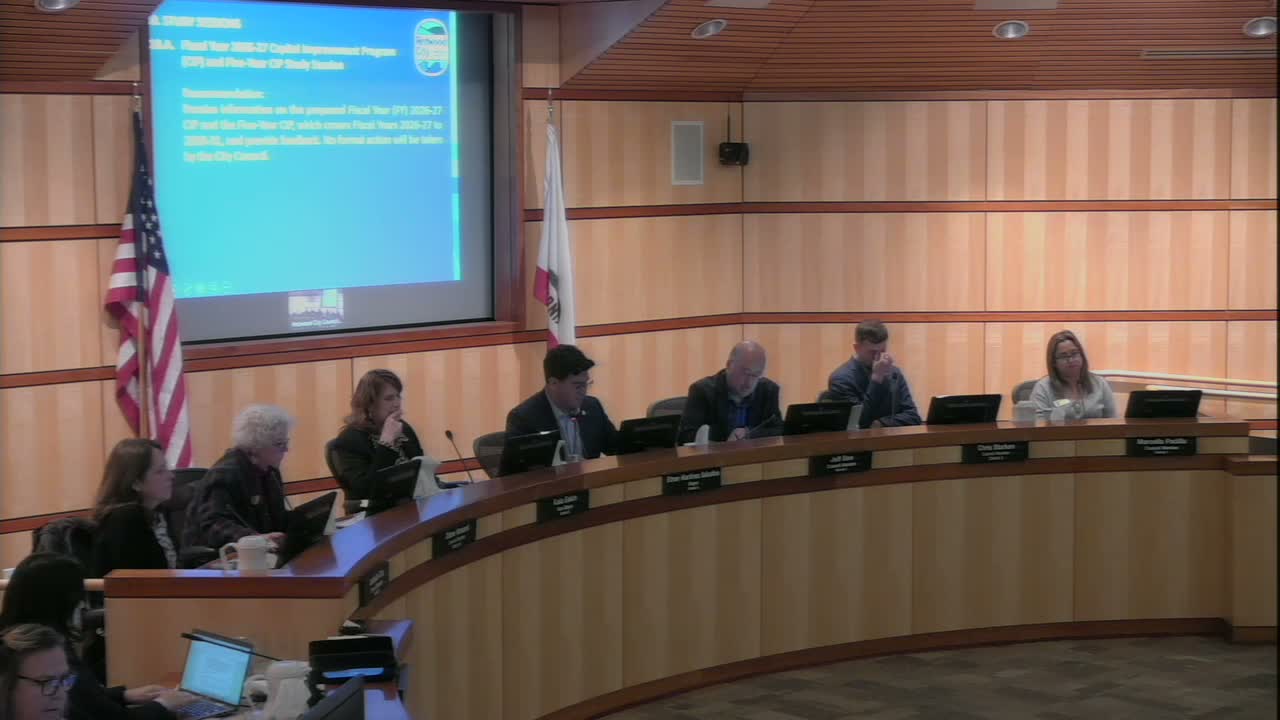
City staff presented the proposed FY26-27 Capital Improvement Program (CIP) at a study session on April 27, recommending $40.5 million in year-one funding and a five-year plan that highlights a roughly $427 million gap between projected needs and likely revenue.
Finance Director Beth Goldberg said the city's capital funding relies on several constrained sources — most notably a stagnant utility users tax (about $11.7 million annually) for general capital outlay, grants, impact fees and water/sewer enterprise funds. "For the next five-year period we are projecting a shortfall of $427,000,000," Goldberg said, outlining that staff received roughly $58.9 million in requests for the coming year but could fund $40.5 million.
Department directors outlined priority projects: engineering highlighted the SR-84/US-101 Woodside interchange reimagining (estimated $384 million, right-of-way in progress) and Redwood Shores sea-level rise protection (estimated ~$200 million) as multi-year efforts; the city also plans stormwater master planning, sewer collection improvements and a Page Street bike boulevard in an equity priority area.
Public Works Assistant Director Adrian Lee described ongoing system-maintenance programs, SCADA rehabilitation, and an EV charging program funded in part by a PCE grant. Parks staff proposed demolition and parking adjustments tied to the Veterans Memorial/Senior Center project and synthetic-turf replacement at Red Morton Park. Interim Library Director Sarah Latora proposed redesigning downtown library restrooms to address safety and access.
During public comment, residents urged changes to the Laurie Duncan Park pilot and removal or aesthetic improvement of temporary orange barricades that have been in place about a year. Councilmembers asked for additional neighborhood outreach on the pilot and asked staff to consider interim fixes if funding delays continue.
Council discussion focused on several recurring themes: setting long-term capital policy and reserves, pairing a municipal advisor with a facilities assessment to inform debt and revenue strategies, prioritizing equity-priority projects in underserved neighborhoods, and exploring alternative revenue sources including grants, joint ventures, and targeted private fundraising for large projects such as sea-level rise protections.
City staff said they will issue an RFP for a municipal advisor and recommended funding for planning and readiness (facility assessments, master plans) so the city can better position projects for grants and financing. No formal council action was taken; staff will return with budget adoption items in June and the council's finance and audit subcommittee will pursue longer-term capital-funding strategies.
What to watch: the municipal advisor procurement and the June budget sessions when the council will consider the first-year appropriations and any adjustments to the CIP.