Get Full Government Meeting Transcripts, Videos, & Alerts Forever!
Get email alerts on the Tobacco Retail Permits topic
No spam. Unsubscribe anytime.
Redwood City council moves to adopt San Mateo County's tobacco retailer rules amid debate over hookah exemptions
Summary
After hours of public comment and council debate, Redwood City's council voted 5-2 on April 27 to introduce and waive first reading of an ordinance adopting San Mateo County's tobacco retailer permit program by reference, setting a June 8 hearing; supporters cited youth protection and enforcement efficiency, opponents warned of harm to grandfathered hookah-serving restaurants.
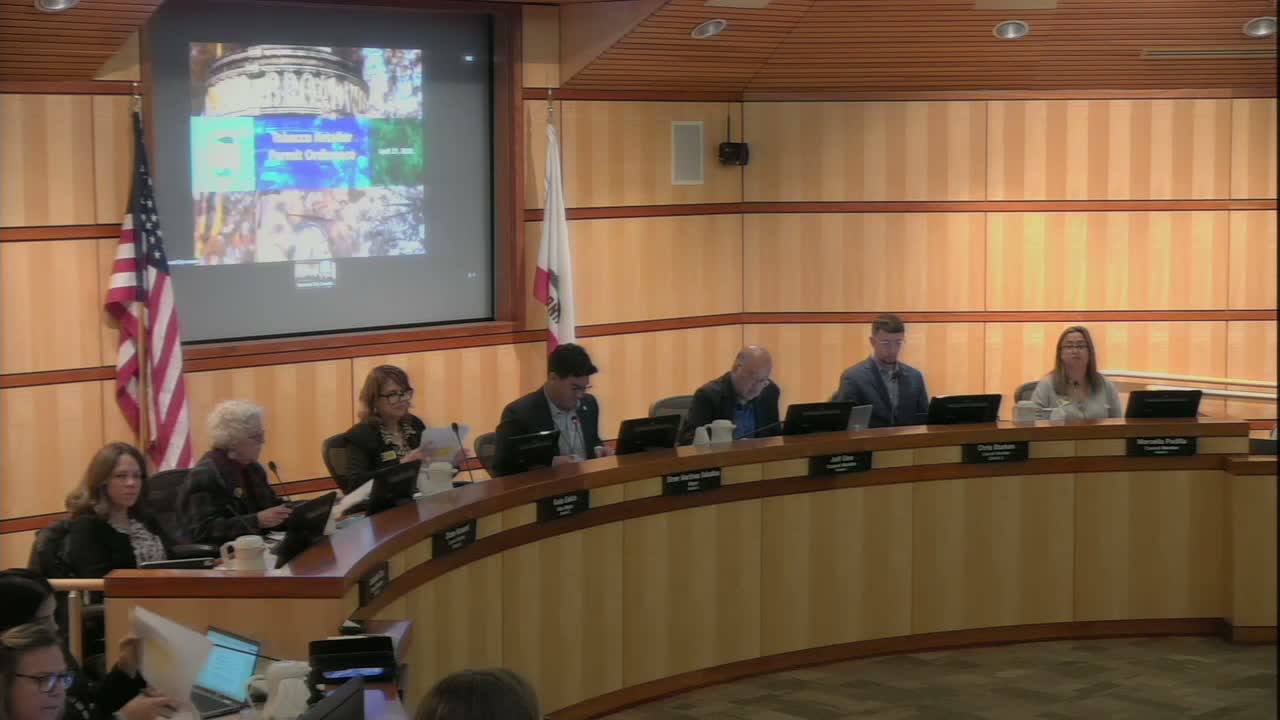
The Redwood City Council voted 5-2 on April 27 to introduce and waive first reading of an ordinance that would adopt San Mateo County's tobacco retailer permit rules by reference and set a June 8 public hearing for second reading.
Amanda Anthony, the city's economic development manager, told the council the county model would be the most cost-effective and immediately implementable approach for strengthening inspections, penalties, and limits on flavored tobacco and electronic smoking devices. "If we go with the county ordinance, the county manages all the administration at no cost to the city's general fund," she said, and county enforcement could begin soon after the ordinance takes effect.
The county's model prohibits new tobacco retailers within 500 feet of existing retailers, bars changes in ownership within 1,000 feet of youth-populated areas (schools and parks), disallows discounts and coupons, and bans all flavored tobacco and e-cigarette sales, Anthony said. She noted the county does not permit the exemptions for flavored hookah tobacco that Redwood City previously allowed.
Public health groups, school-based youth speakers and regional advocates urged adoption. Blythe Young of the American Heart Association said the county ordinance was based on "best practices" and called for consistent licensing and proactive inspections. "Adopting the county's policy will help protect the community from tobacco addiction," Young said.
Owners and staff of three downtown establishments that have offered on-site hookah said the proposal would strip longstanding grandfathered permissions and harm small businesses. David Kasouf, owner of The Sandwich Spot, said his restaurant had relied on the 2021 grandfather exception when investing in leases and staff: "Removing that exception now would have a devastating impact on my business, my family, my employees," he said.
Several councilmembers pressed staff and county environmental health staff for details about enforcement, distance buffers, and how hookah-serving restaurants might adapt. Waymond Wong of San Mateo County Environmental Health confirmed the county ordinance includes paraphernalia and electronic smoking devices in the enforcement scope and that county inspectors would conduct two unannounced inspections per year for permitted businesses.
Councilmember Chiu said newly available public health evidence persuaded her to back the county model: "A single hookah session is equivalent to smoking a hundred cigarettes," she said, citing a pediatrician's letter included in the record, and added she would support adopting the county ordinance to make enforcement simpler and more cost effective.
Vice Mayor Aiken moved the staff recommendation to introduce and waive the first reading and set a June 8 public hearing; Councilmember Chiu seconded. The motion carried with five votes in favor; Councilmembers Padilla and Sterkin voted no. The council's motion does not itself ban any current business immediately; it places the ordinance on a formal track for adoption by reference at a later hearing.
What happens next: If the council adopts the ordinance at the second reading, San Mateo County staff told the council they would identify existing licensed businesses, conduct outreach, require businesses to apply for county permits, and begin routine and complaint inspections shortly thereafter. County staff said businesses that want to remain open could consider nicotine-free alternatives that other Bay Area cities have adopted.
The council's action was presented as a choice between local cost and staffing limitations or county-managed licensing and enforcement. Supporters argued adopting the county model would reduce youth access and strengthen compliance; opponents warned it would remove a protection for culturally rooted downtown businesses that have operated under a grandfather clause.
The council will return June 8 for the ordinance second reading and final vote.