Get email alerts on the Annexation topic
No spam. Unsubscribe anytime.
Enumclaw council reviews two annexation requests, asks staff to draft modified resolutions
Summary
City staff presented two proposed annexations covering areas on the east and west sides of Enumclaw; councilmembers asked staff to prepare modified resolutions (likely two) and requested legal and consultant‑cost guidance before applicants pursue signatures under the 60% petition method.
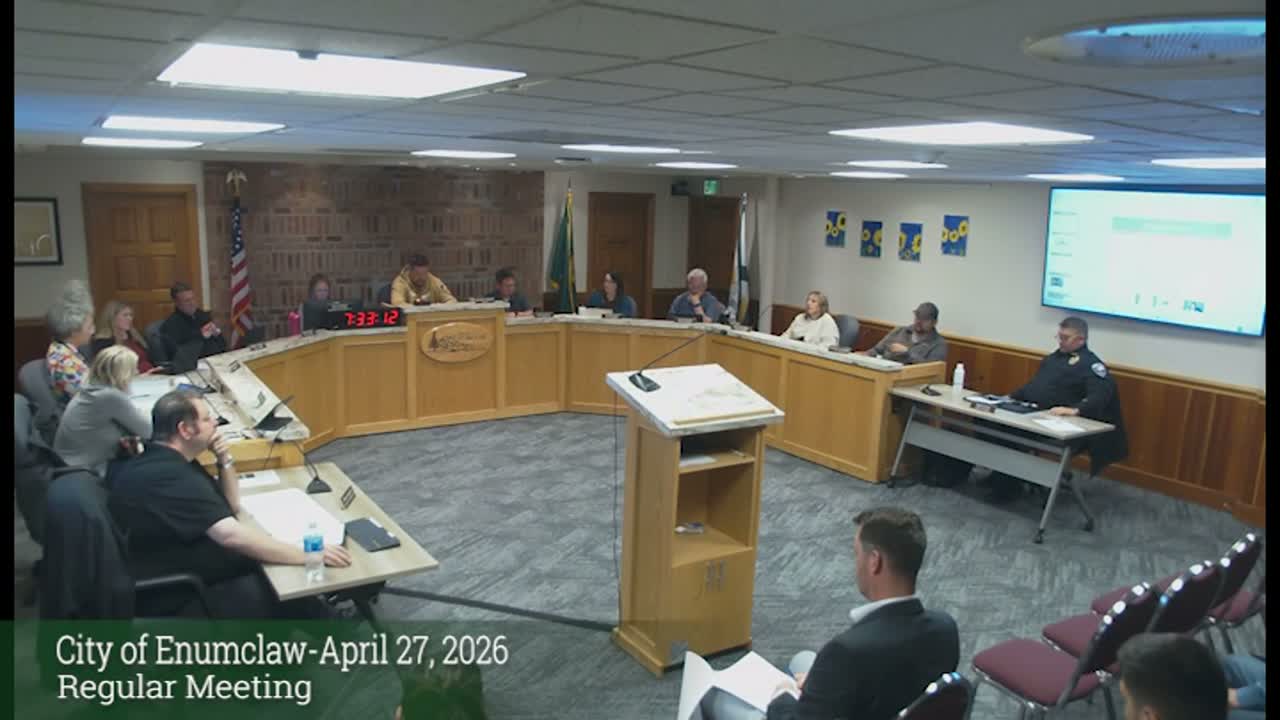
Enumclaw’s City Council reviewed two annexation requests at its April 27 meeting and signaled that staff should prepare draft resolutions to modify the proposed boundaries and likely process the requests separately.
Community Development Director Chris Massenet told the council the city received two petitions in March covering five parcels (about 18 acres as submitted) and that staff’s preferred modifications would expand the areas to roughly 38 acres with an assessed valuation of about $8.5 million. Massenet said some parcels already have water and sewer stubbed nearby and recommended boundary changes to keep the city limits regular and to comply with the comprehensive plan.
Why it matters: Annexation changes who provides services, what zoning applies and which governing body represents property owners. County vs. city jurisdiction affects utility connection costs, development rules and tax responsibilities for any properties involved.
Council members questioned process, fairness and the city’s capacity to manage multiple annexations. Massenet explained the 60% petition method and cautioned that if the council did not modify the presented boundaries the Boundary Review Board might require changes. “It’s highly likely too that if we didn’t do that, the boundary review board would probably require that of us,” Massenet said.
Council discussion focused on two practical points: whether the Tarragon parcels by themselves would meet the 60% valuation threshold (staff said they would not) and whether applicants could be required to cover consultant or staff costs to process annexations. One council member asked staff to consult with the city attorney about conditioning approval on applicant payment for consultant support to avoid overloading city staff.
Rather than take a binding vote, council members gave informal direction by nodding in favor of preparing two separate draft resolutions with the proposed staff modifications and asked staff to return with legal guidance and draft language. Massenet noted he did not need a formal roll call: “I don’t think I need a vote per se. Some head nods would be okay.”
Next steps: Staff will consult with the city attorney about possible conditions (including whether applicants may be asked to fund consultant work), prepare draft resolution(s) reflecting the modified boundaries and return to council within the statutory timeline so the parties can decide whether to proceed with signature collection under state law.
AI generated
The text on this page is AI generated. Summaries, highlights, analysis, and video transcripts are all produced from the original source material.
AI can make mistakes, so if you spot one, and we will fix it for everyone.
Note: the source content is unaltered by us. Any content source we link to, be it a video, an audio recording, or a document, is presented exactly as its publisher released it. That publisher is usually a government body, sometimes an individual official or another organisation.