Get Full Government Meeting Transcripts, Videos, & Alerts Forever!
Get email alerts on the Education Leadership topic
No spam. Unsubscribe anytime.
Lynwood Unified superintendent lays out 'Vision 2030' emphasizing AI literacy, safety and signature school programs
Summary
In his first State of the District on Oct. 17, 2025, Superintendent Dr. Patrick Giddis Rabbongo outlined Vision 2030, prioritizing safe and modern campuses, signature programs at each school, expanded mental-health supports and AI literacy for students and staff.
Dr. Patrick Giddis Rabbongo, superintendent of the Lynwood Unified School District, used his first State of the District address on Oct. 17, 2025, to unveil a five‑year Vision 2030 that centers on safe, modern campuses, school‑level signature programs and a districtwide push to build AI literacy among students and staff.
"Every student we serve is someone's whole world," Dr. Rabbongo said, framing the plan around student-centered supports. He said his initial 100 days in the post were devoted to ‘‘listen, learn, and lay a strong foundation,’’ including community forums, student advisory council meetings and visits to classrooms to identify priorities.
Those early engagements, he said, produced four priorities: safe and modern campuses; rigorous, real‑world learning; expanded mental‑health and family supports; and deeper work on AI and data. "We want every Lynwood school to develop its own signature program," he added, describing a portfolio of schools that each highlight strengths from STEM and robotics to dual language and the arts.
On instruction, Dr. Rabbongo proposed a districtwide focus on the framework of "claims, evidence and reasoning" to sharpen student thinking and communication. He emphasized relationships as foundational to learning, saying strong adult‑student connections boost attendance and engagement.
Dr. Rabbongo also placed technology and artificial intelligence at the center of the district's strategy. He described an AI task force, responsible‑use guidelines, classroom pilots and staff training, saying, "AI isn't replacing staff, it's not replacing teachers; it augments instruction and strengthens human reasoning." He framed the goal as ensuring equitable access and purposeful use so students are prepared for an AI‑driven world.
The superintendent tied Vision 2030 to the district strategic plan and board goals — academic excellence, facilities and safety, community advocacy, and culture and climate — and invited the community to engage with the plan through the district's Vision 2030 resources and forthcoming recap video. He closed the address by asking attendees to help implement the priorities through continued partnership and local support.
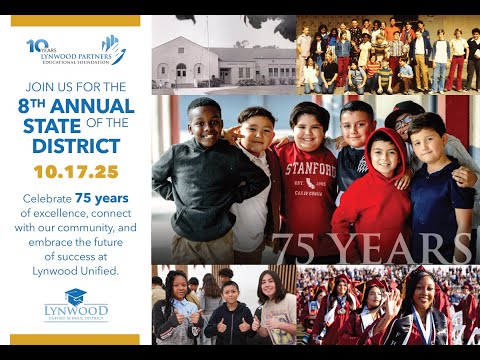
The address took place during the district's 75th anniversary celebration and was presented in partnership with the Lynwood Partners Educational Foundation. Dr. Rabbongo closed by thanking students, staff and community partners and by encouraging continued collaboration to turn the plan into measurable action.