Get Full Government Meeting Transcripts, Videos, & Alerts Forever!
Get email alerts on the Surveillance Flock topic
No spam. Unsubscribe anytime.
Los Altos Hills technology committee presses Flock for tighter data controls, delays renewal recommendation
Summary
After extended public comment and a technical briefing from Flock, the committee voted to ask for a detailed technical review, amend the town's data-sharing agreement to ban national lookup and strengthen damages clauses, and present recommended changes to the city council before any renewal decision.
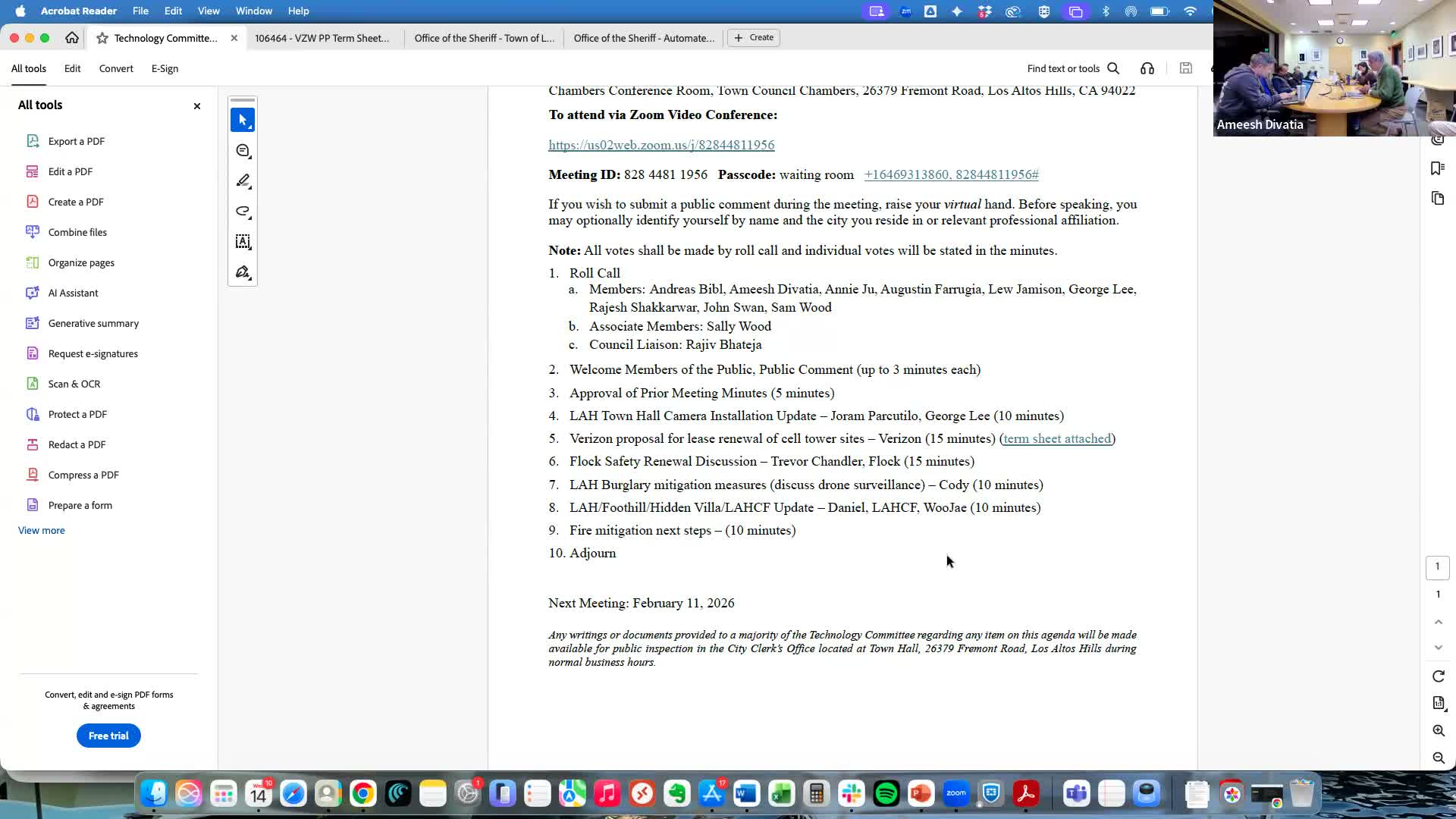
The Los Altos Hills Technology Committee voted to ask the Town Council for more time and technical briefings before deciding whether to renew a Flock Safety license-plate–recognition contract, and it instructed staff to pursue contract amendments to tighten data-sharing controls.
Committee members, staff and multiple public speakers raised concerns about privacy, national lookups and the security of long-term data holdings during an extended discussion after Flock’s public-affairs director, Trevor Chandler, answered technical questions. Chandler said Flock has disabled the national lookup feature for all California customers and that the company does not own or sell customer data, adding that “we have shut off all access for outside agencies for California data” and that Flock notifies customers if a subpoena or warrant is received. He described a default 30‑day retention policy and said agencies can negotiate different retention periods.
The committee’s motion — seconded and approved by the committee — directs the technology committee to conduct additional technical review with Flock (including a CTO-level discussion of encryption, key custody and audit controls) and to draft recommended amendments for the town’s data-sharing agreement. Committee members said they want explicit contractual language banning any national-lookup capability, stronger technical protections (for example, bring-your-own-key or two-person access controls), and higher liquidated‑damages provisions in the event of unauthorized disclosures.
Public commenters emphasized civil-liberty risks and cited other cities that have canceled Flock contracts. Austin Marshall, a member of the public, told the committee the town should “reconsider its position on this invasive surveillance technology.” Blaine Garst, a computer-systems expert, warned of prior breaches and the potential for legal and administrative burdens if data requests proliferate.
Town staff noted the current renewal structure is negotiated on a fiscal-year basis: the contract operates as a one-year term that can be renewed into a price-locked five‑year commitment; the municipality is able to decline renewal with advance written notice (contract notice windows were discussed during the meeting). The committee requested specific documentation from Flock — including penetration-test reports, architecture details about multi-tenant data separation, information about key management, and a demonstration of the planned proactive auditing tool — and said it will seek draft contract language to bring to council.
Next steps: the technology committee will convene technical sessions with Flock and prepare proposed edits to the town’s data-sharing agreement for council consideration. The committee also asked staff to confirm retention, notice and termination provisions in the existing contract and to propose higher liquidated-damage figures tied to per-incident violations.