Get Full Government Meeting Transcripts, Videos, & Alerts Forever!
Get email alerts on the Public Safety topic
No spam. Unsubscribe anytime.
Fire district lays out $22M budget priorities; council presses on new station timing, evacuation routes and early-warning pilots
Summary
The Los Altos Hills County Fire District presented its FY 2026–27 draft budget emphasizing life-and-property spending; the district confirmed $6M in county rollovers for I-280 mitigation and a placeholder $15M estimate for a potential new fire facility pending a feasibility study. Council and residents pressed for details on timing, evacuation-route maintenance and early-warning sensors.
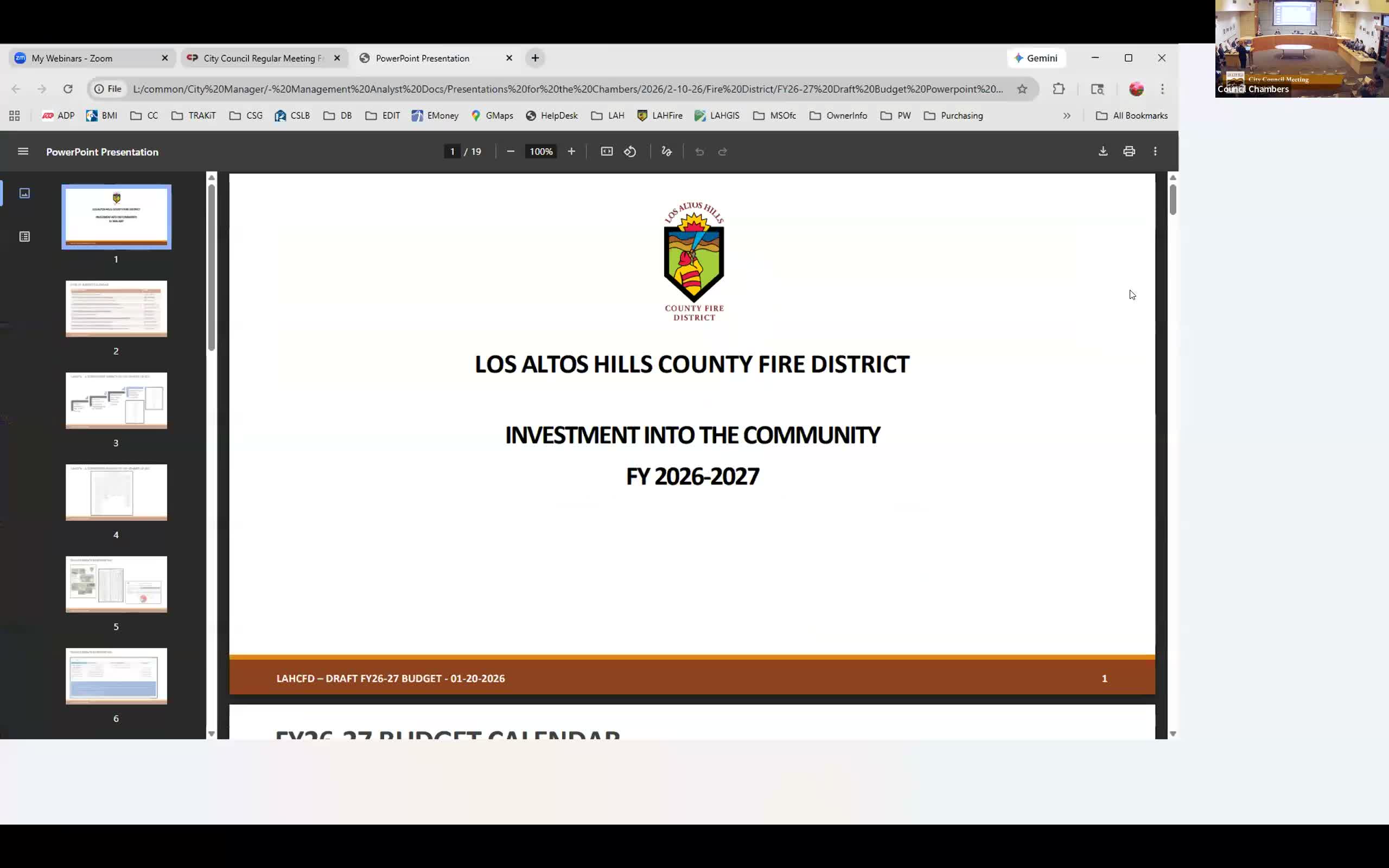
Jay Logan, general manager of the Los Altos Hills County Fire District, and district finance staff presented a budget overview showing roughly $22 million in total expenditures, with about $17 million targeting direct community services such as evacuation routes, chipping, home ignition zone work and communications. Finance manager Russ Moriali said "75% of every dollar we put into the budget, we put into the community," and highlighted that the district has preserved $6 million in carryover funds with county approval to support the I-280 mitigation program and other projects.
On the question of a potential new fire facility, staff said the district has budgeted feasibility and design funds and has a placeholder figure of approximately $15 million in a 10-year forecast, but cautioned that the feasibility study and design work must precede any construction commitment. "The feasibility study is on track for this next year... Once that design and study is done... then we would move to the county and allocate dollars specifically for the construction," the finance manager said.
Council members and residents focused on operational and safety implications: when would the feasibility study finish, how would staffing be funded, and how will evacuation and feeder routes be prioritized and maintained? Deputy Fire Chief Brian Glass described incident-command practices and mutual-aid roles, telling the council that unified command and contingency control lines guide tactical decisions in large wildfires and that protecting lives and evacuating residents may at times supersede structure defense.
The district described early-detection pilots including N-5 sensors and the county's ALERT camera network; district staff said they were participating in county-level pilot planning for sensor distribution and that multiple layers of early detection and notification are being explored. The district agreed to meet with town staff and residents on plan-review issues and to explore opportunities to support the town's emergency-manager planning.
What happens next: staff will bring refined feasibility timelines and further details about rollout of mitigation and sensor pilots back to the district and town; council asked staff to continue regular coordination with the town's emergency-preparedness committees and to report on priorities and grants that could accelerate implementation.