Get Full Government Meeting Transcripts, Videos, & Alerts Forever!
Get email alerts on the View Ordinance topic
No spam. Unsubscribe anytime.
Residents urge caution on revising Los Altos Hills view ordinance during work‑plan discussion
Summary
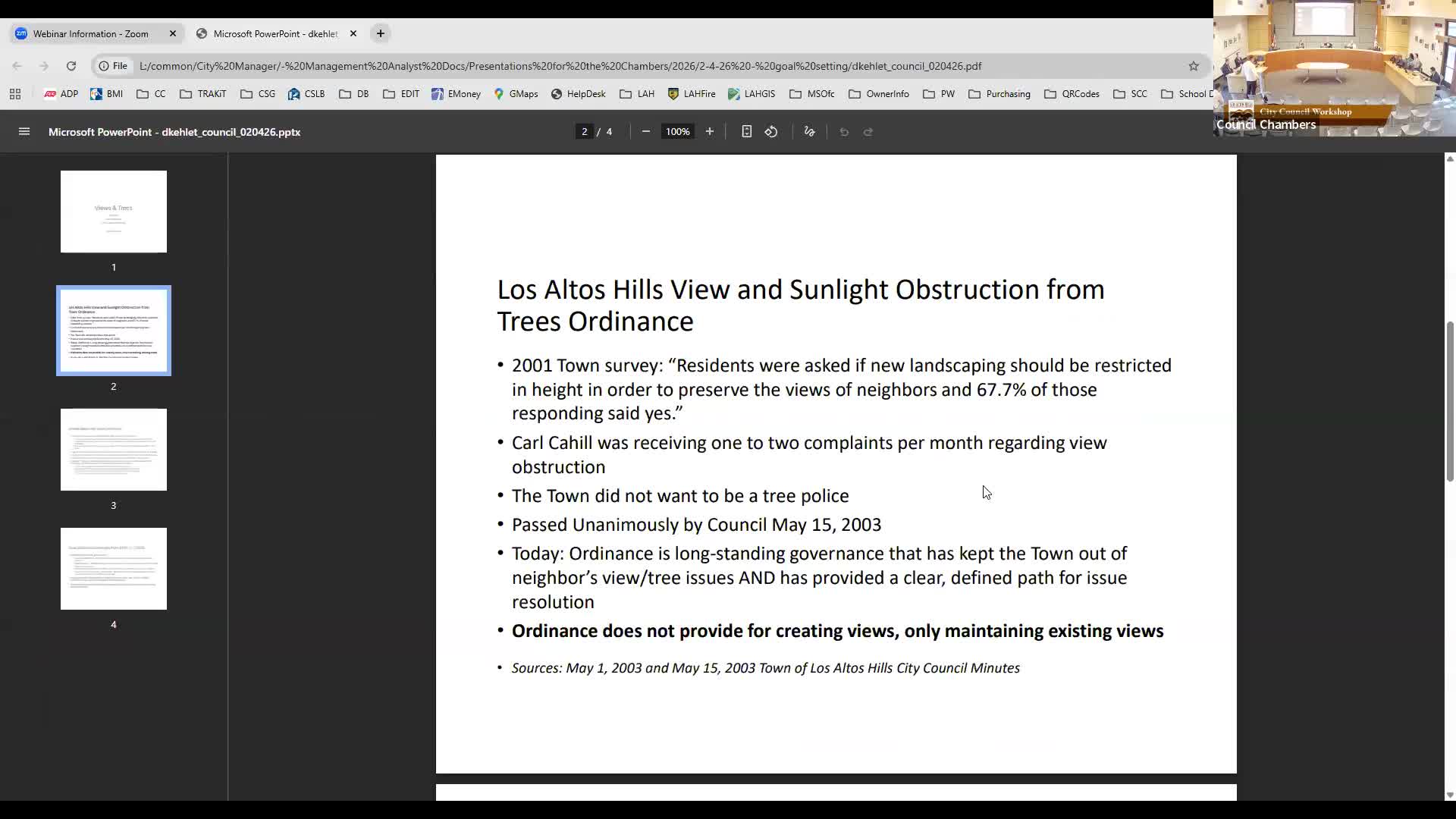
Multiple residents used the council’s Feb. 4 goal‑setting meeting to urge either a full town review of the view/tree ordinance or that the council leave the ordinance alone while encouraging mediation; the council ultimately did not prioritize an ordinance rewrite for immediate staff funding.
Residents with long‑running neighborhood disputes and participants from the Environmental Design and Protection Committee used the meeting’s public‑comment period Feb. 4 to press the council for clearer rules on views and trees — or, alternately, to caution against changing the ordinance while individual disputes remain pending.
Dave Kellett, a Moore Drive resident, asked the council not to rewrite the view ordinance to resolve a single neighbor dispute and proposed a supplemental handout or guide to help residents and mediators interpret and apply the existing ordinance. "How about create a supplement to the view ordinance instead of revising the ordinance?" Kellett said, describing a stalled mediation with his neighbor and warning that a wholesale change could discourage negotiated settlements.
Other speakers expressed opposing concerns. Gerda Crystal, a long‑time resident, said the town’s current codes favor "view seekers" and urged clarification of distinctions — for example, whether a clear‑cut view can later be considered a preexisting view. "Long term residents have one interpretation and new property owners have another," Crystal said, arguing the code should be made fair and consistent for annexed areas and long‑standing parcels.
Bridgette Morgan, who served on a subcommittee that examined the ordinance, recommended the council evaluate the ordinance town‑wide rather than on the basis of a single case and suggested the committee’s prior work provide a useful starting point. Karen Kelly, whose family is involved in an active dispute, urged the council to encourage mediation and to allow the ordinance to operate as written: "We are not horrible people trying to force our neighbors to rip the trees out... We simply want them to trim back their trees to earlier levels," Kelly said.
Staff and commissioners clarified process: the planning commission had referred the matter to the Environmental Design and Protection Committee for detailed review; staff noted the view municipal code update was listed in the packet as beyond capacity and would require scope and staffing if the council wanted it elevated.
Outcome at the meeting: after council prioritization and the dot‑voting exercise, the view ordinance review did not receive sufficient votes to be added as a funded project in the proposed budget. Staff later summarized the outcome by listing the view ordinance among items that did not make the prioritized add list; council members and staff said committee or future council‑initiated processes remain available to revisit the code if consensus emerges.
What to watch: if the council or a committee elects to pursue municipal code changes, staff said it would return with a scope, timeline and any budget implications. Until then, residents said mediation remains the preferred route to resolve individual disputes.