Get Full Government Meeting Transcripts, Videos, & Alerts Forever!
Get email alerts on the Housing topic
No spam. Unsubscribe anytime.
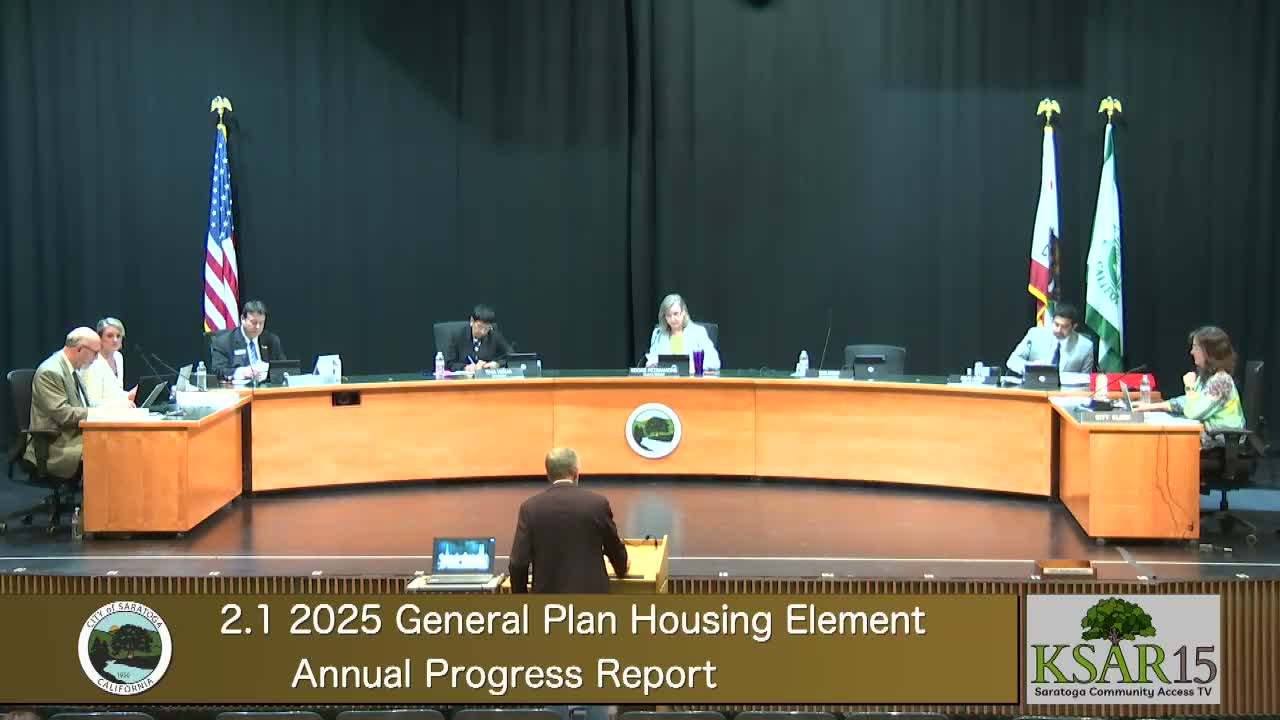
Saratoga council approves 2025 housing progress report, directs staff to study ADU fee waivers
Summary
The Saratoga City Council accepted the 2025 Annual Progress Report on the housing element and directed staff to analyze a local fee waiver for accessory dwelling units, including deed‑restricted units and converted pool houses, as a way to meet aggressive RHNA targets.
The Saratoga City Council on March 18 accepted the city’s 2025 Annual Progress Report (APR) on the housing element and directed staff to evaluate a local fee waiver to encourage accessory dwelling units (ADUs).
Staff presented the APR, saying Saratoga’s 2023–2031 RHNA allocation is 1,712 units and that the city issued 556 building permits since 2023 and added 214 units in 2025, including ADUs and deed‑restricted townhomes. The report will be filed with the Department of Housing and Community Development and the Office of Planning and Research after council approval.
Why it matters: Saratoga is working to meet a large state-assigned housing target; councilmembers said incentivizing ADUs and counting conversions more flexibly could help the city make progress without major zoning changes. Councilmember Fitzsimmons urged staff to return with numbers showing the fiscal impact of a local fee waiver, saying fee relief could remove barriers to deed‑restricted ADU construction.
During questions, staff said a converted pool house that is brought up to the dwelling‑unit standard (kitchen and bathroom) counts toward the city’s ADU inventory and RHNA credit once a building permit is issued. Staff and council discussed using the next fee schedule to test a targeted local waiver, with priority for deed‑restricted units.
Public commenter Glenn Berries urged the council to accept the report and warned that the next RHNA cycle could impose still higher allocations; he called on local leaders to advocate for changes to the RHNA methodology at the county and state level.
The council approved the APR by motion and vote and gave staff direction to analyze ADU fee-waiver scenarios and potential pathways to count more existing dwelling conversions in the city’s inventory. The council asked staff to bring back numbers tied to the fee schedule and to consider outreach and implementation steps.
The council’s approval was procedural; the staff analysis on fee waivers and any policy changes would return in a future agenda item and, if implemented, would require council action.