Get Full Government Meeting Transcripts, Videos, & Alerts Forever!
Get email alerts on the Wireless Infrastructure topic
No spam. Unsubscribe anytime.
Planning Commission backs 10‑year renewal for T‑Mobile steeple antennas at St. Luke’s Chapel
Summary
The Los Altos Hills Planning Commission voted unanimously April 13 to recommend city council renew the conditional use permit for T‑Mobile’s stealth wireless facility in the steeple at St. Luke’s Chapel, approving a 10‑year term and leaving staff discretion on RF reports unless complaints or upgrades arise.
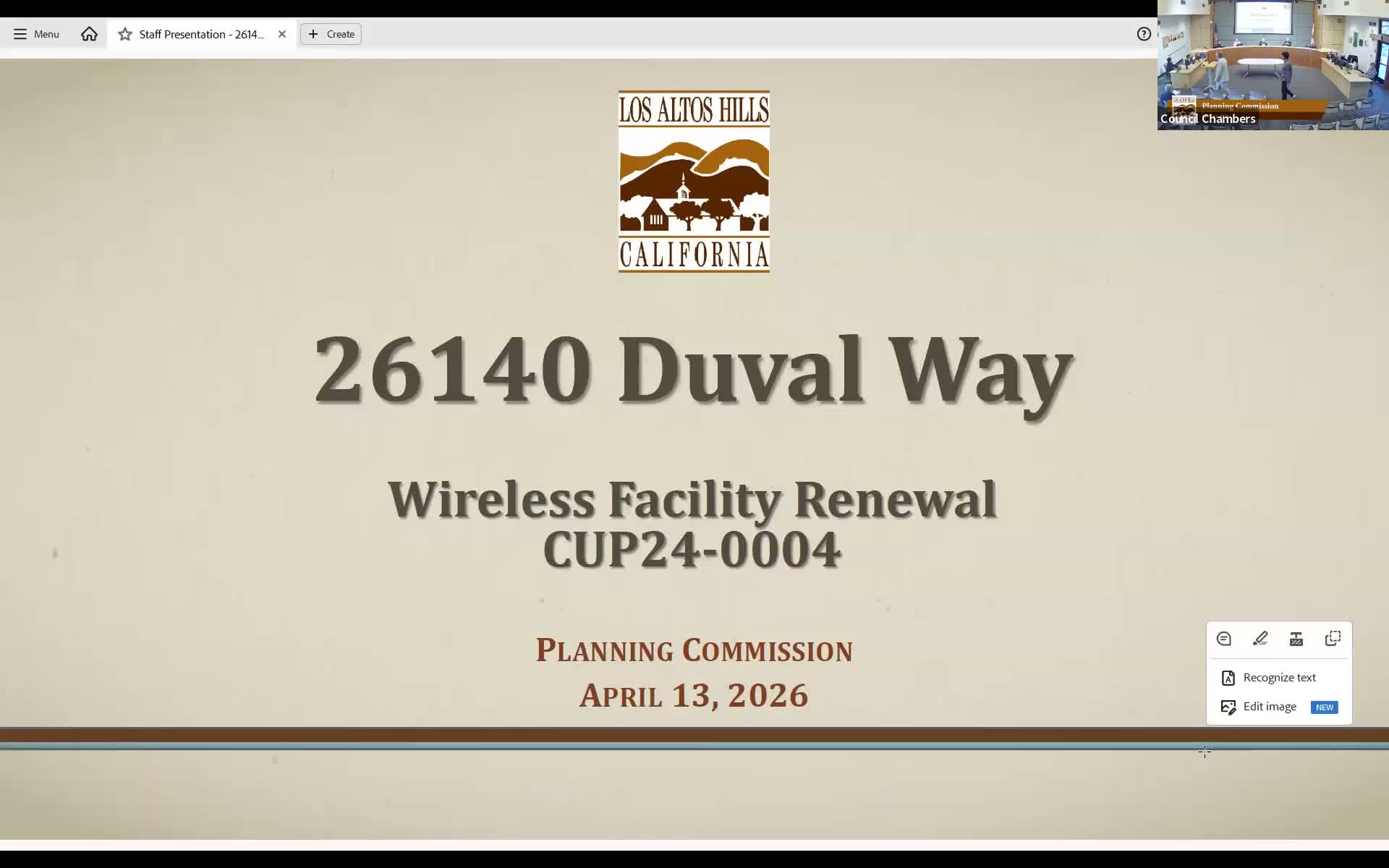
The Los Altos Hills Planning Commission on April 13 recommended city council approve a 10‑year renewal of a conditional use permit for a T‑Mobile wireless facility hidden in the steeple of Saint Luke’s Chapel in the Hills.
Senior planner Jonathan Fox presented the staff report, saying the renewal (file CUP 24‑0004) involves no changes to the existing equipment or exterior structures. Staff recommended extending the renewal period from a three‑year cadence to 10 years — consistent with the town’s modern code — and suggested shifting the town’s annual radio‑frequency (RF) reporting requirement to a complaint‑triggered or upgrade‑triggered system so full RF reports would be required only when there are signs of equipment failure or a public complaint.
Why it matters: the steeple site sits on a historically listed property and neighbors raised questions about on‑site ground equipment near a nursery and whether upgrades could change emissions or visibility. Clark Patterson, who said he sits on Saint Luke’s Chapel’s board, told commissioners T‑Mobile had provided an RF study done in December and that the report showed levels within limits. He also said T‑Mobile plans could double the number of antennas and increase electrical service capacity, prompting discussion about shielding and power upgrades.
T‑Mobile’s representative, Jillianne Newcomer, described the company’s standard RF practice: a qualified RF engineer conducts on‑site measurements at accessible locations where people may be present and compares measured/predicted levels to FCC public‑exposure limits. She said the company provides those reports on request and with modifications.
Commissioners discussed EDPC’s nonbinding recommendations — screening of ground equipment visible only inside the site, a metal divider for fire separation, and pruning a pepper tree — and agreed they were appropriate suggestions but not conditions of approval. Staff confirmed that any future physical change that increases height or alters the exterior would return to planning commission for review; changes that are strictly internal or limited to power increases might only go to building review depending on FCC rules.
A motion to adopt the draft resolution finding a categorical exemption under CEQA (Section 15301(b)) and forward a recommendation to city council passed unanimously on roll call. The commission’s recommendation carries a 21‑day appeal period before council consideration.
The commission’s action was procedural; final approval rests with the city council.