Get Full Government Meeting Transcripts, Videos, & Alerts Forever!
Get email alerts on the Transportation Jefferson Avenue topic
No spam. Unsubscribe anytime.
Council approves Jefferson Avenue safety overhaul, backs ‘Alternative B’ road diet and bike lanes
Summary
The Redwood City Council unanimously adopted staff-recommended Alternative B for the Jefferson Avenue Traffic Safety Improvement Project, endorsing a road diet, center-turn lanes and bike facilities on key segments. The council approved the construction-ready design after robust neighborhood outreach and public comment; the project is largely grant-funded.
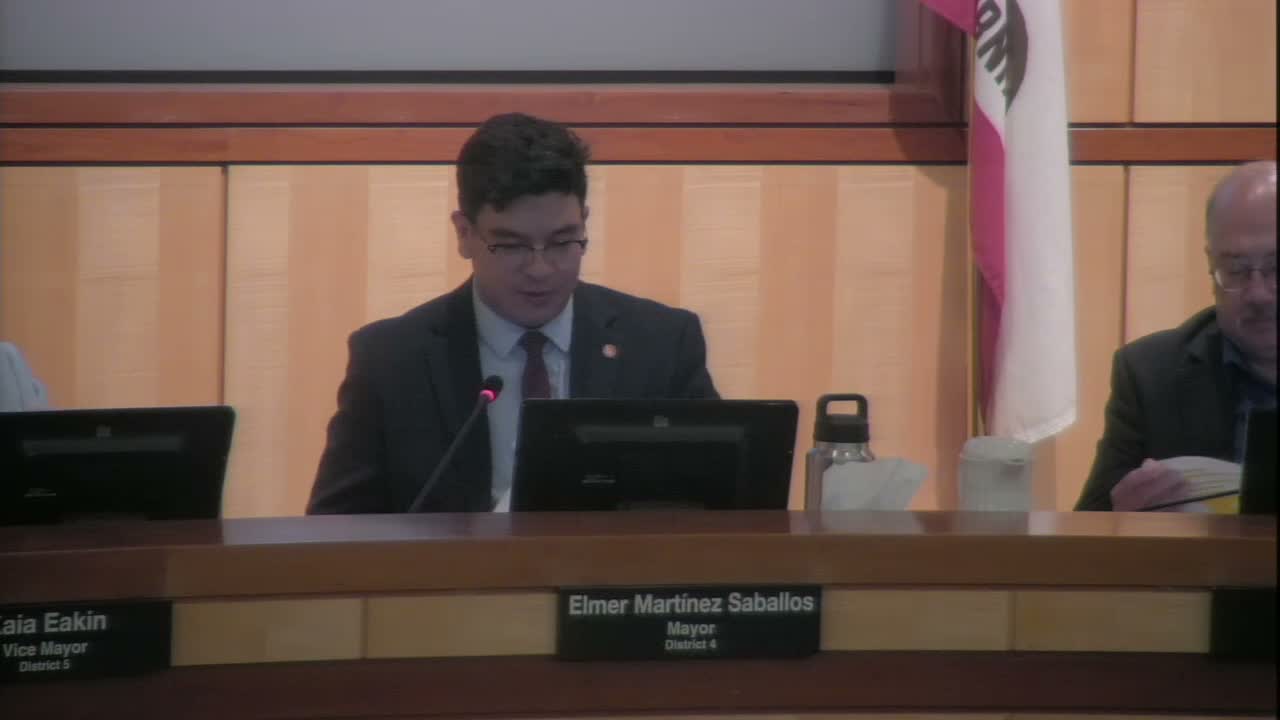
The Redwood City Council on Jan. 26 voted unanimously to adopt the staff-recommended Jefferson Avenue Traffic Safety Improvement Project—Alternative B—a corridor redesign that will add a center turning lane, bike lanes on most segments, curb extensions and new crossing treatments aimed at reducing collisions.
The vote followed a months-long outreach process in which staff held multiple community meetings, mailed notices to roughly 2,400 addresses near the corridor and solicited online feedback. Principal transportation planner Malaha Orang said the corridor has been identified as part of the countywide high-injury network and that “since 2017 there have been 101 collisions on Jefferson Avenue between Farm Hill and El Camino, 15 of which involved pedestrians and four involved bicyclists,” arguing that Alternative B “aligns with our Vision Zero commitment to reduce collisions.”
Why it matters: staff and residents framed the project as a safety priority for families, school children and regular bike and pedestrian users of Jefferson. The recommended design reduces travel lanes to one in each direction on much of the corridor to make room for dedicated bike lanes and a center turn lane that staff said will reduce queuing and the risks created when turning vehicles block through traffic.
Public comment was strongly in favor. Ulysses Manseron, a Jefferson resident who bikes with his toddler, told the council the existing conditions create dangerous crossing points for families: “Having a single lane would prevent people from passing between cars and trying to go fast,” he said. Multiple neighborhood leaders and parents asked the council to incorporate additional physical protections for bicyclists where feasible, including delineators, flex posts or low barriers.
Design details and tradeoffs: Alternative B includes curb extensions, pedestrian refuges, a new traffic signal at Valota, rectangular rapid-flashing beacons and flashing crosswalks at several intersections, and a mix of Class 2 (painted) bike lanes and protected segments where driveways are less frequent. Malaha Orang said the corridor’s frequent driveways made a continuous parking-protected bike lane infeasible for most blocks. Staff said pockets of protected Class 4 bikeway are proposed in areas with fewer driveway interruptions.
Costs and funding: staff estimated Alternative B at roughly $8,000,000 and reported $5,500,000 in grant commitments from the San Mateo County Transportation Authority and the Metropolitan Transportation Commission housing-incentive program; the remainder would come from local pavement, transportation impact and ADA funds. Staff characterized the project as fully funded at the time of presentation but noted federal funding requirements (NEPA/Caltrans clearances) that must be met before construction authorization.
Council direction and outreach: Councilmembers asked staff to seek additional physical separation where right-of-way allows, to add wayfinding to tie lower-stress bike routes into the corridor, and to continue the intensive neighborhood outreach during design and construction. Several members requested an educational campaign about devices such as HAWK signals and RRFBs and urged avoiding major construction starts during the first week of school.
What’s next: staff will begin final engineering, environmental clearance (CEQA/NEPA where required) and grant authorization work, with design completion and Caltrans funding authorization targeted by January 2027 and potential construction bidding and installation starting in 2027. Councilmember Sturkin moved to approve Alternative B; the motion was seconded by Councilmember Howard and passed on a unanimous roll-call vote.