Get Full Government Meeting Transcripts, Videos, & Alerts Forever!
Get email alerts on the Elections Administration topic
No spam. Unsubscribe anytime.
Presenter walks Albemarle County polling workers through Statement of Results procedures
Summary
Albemarle County Department of Elections delivered training on completing the Statement of Results (SOR), covering when to use hand-count sections, how to attach DS200/DS300 tapes, signature requirements under the Code of Virginia, and procedures for calling in and securing results.
Presenter led a training session for Albemarle County election officers on how to complete and handle the Statement of Results (SOR), the official record used by the registrar and electoral board to certify vote tabulations. The session covered SOR copies, printed return sheets, hand-count procedures, tape attachment, signature locations, and statutory obligations.
The presenter emphasized statutory signing requirements under the Code of Virginia, saying, "You shall sign the statement of results. You're not signing that you agree with the outcome. You're only signing that to the best of your knowledge the law was followed in your polling place." The training cited Code of Virginia §24.2-667 for the signing requirement and §24.2-657 regarding announcing results in the polling place when calling them in to the registrar.
The session reviewed where SORs are produced in Albemarle County: 30 precinct polling places, a separate early-voting SOR broken out by precinct, a central absentee precinct (CAP) by mail, a CAP post-election batch for late-arriving absentee ballots, and a provisional precinct for ballots accepted after adjudication. The presenter stressed that many CAP and provisional SORs are counted by precinct and that not all SOR types have identical required tapes or form sections.
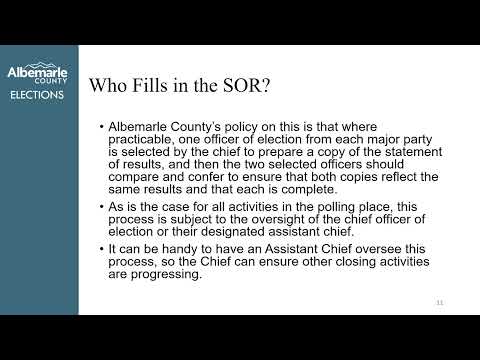
Practical steps covered included preparing two identical SOR copies (registrar and circuit court), attaching DS200/DS300 opening and closing tapes and any applicable write-in tapes, placing both SOR copies in envelope two, and putting the printed return sheet in envelope 2A. Officers were instructed to fold thermal printer tapes pleat-style so they remain readable, staple near the top, and secure folded tapes with a paper clip so they do not unwind in the envelope.
The presenter walked through SOR sections: Section A (poll pad zero and summaries), Section B (DS200/DS300 scanned ballots and any hand counts), Section C (provisional ballot totals by type, taken from the provisional ballot summary log) and Section D (hand-count results). Section D was emphasized as optional and election-specific: "Omit part D of the statement of results if it's not needed," the presenter said, adding that including an empty Part D can create confusion about whether hand counts occurred. Officers were shown how to transfer one set of hand-count results to both SOR copies when a hand count is required.
The training addressed overvotes and undervotes and a simple totals check: each race's total (votes plus undervotes/overvotes) should match the number of ballots processed so reviewers can reconcile counts across races. The presenter described using the Virginia guide to hand counting ballots for partisan teams to agree on voter intent during hand counts.
Signature logistics were explained in detail: each officer should sign multiple locations (three signatures on DS300 result tapes, one signature on each of the two SOR copies, and one on the printed return sheet), resulting in six signature instances per officer. After completing and comparing both SOR copies line-by-line, officers should staple pages together, deliver copies to the chief for review, call results into the registrar's office on speakerphone so all officers can hear, and then seal envelopes with signatures of two officers before returning materials to the registrar.
The presenter closed by underscoring the SOR's role: it records the voters' will, supports registrar reporting, and provides the documentation the electoral board uses to certify results. The session emphasized accuracy, legibility of attached tapes, and adherence to statutory requirements when completing the SOR.