Get Full Government Meeting Transcripts, Videos, & Alerts Forever!
Get email alerts on the Land Use Gdap topic
No spam. Unsubscribe anytime.
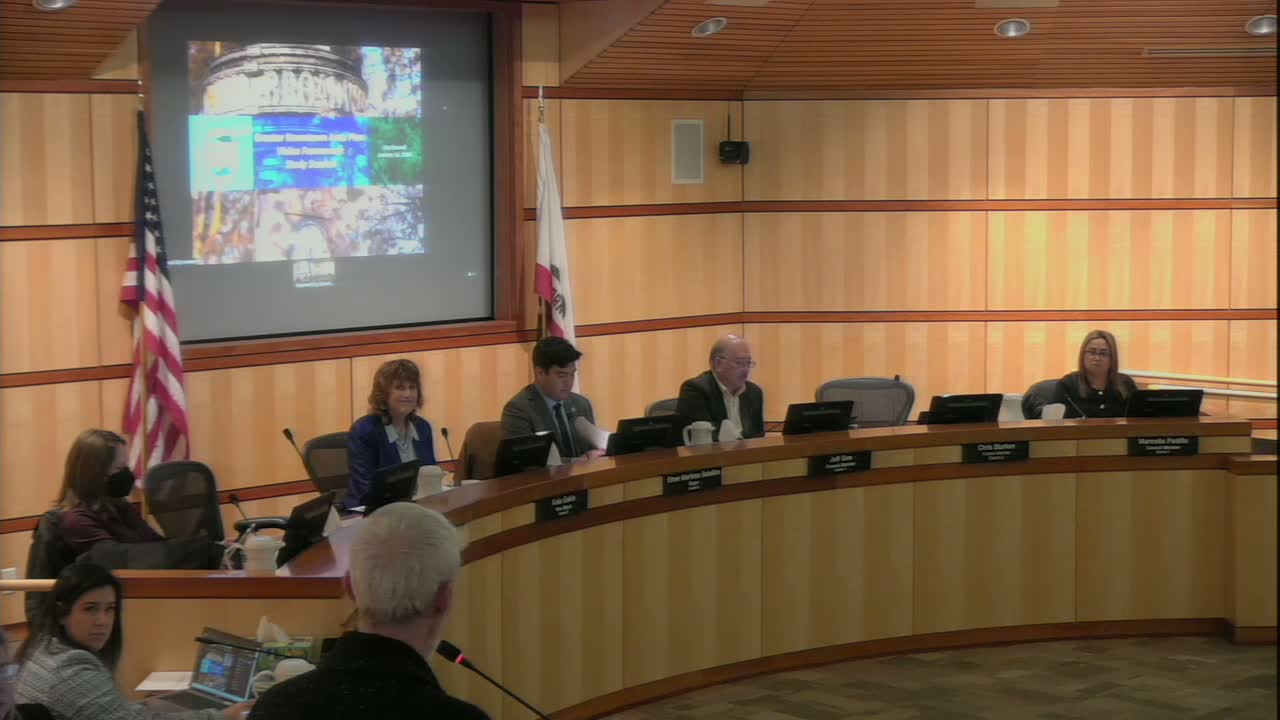
Redwood City reviews draft Greater Downtown Area Plan vision, focuses on mobility and climate resilience
Summary
City staff and consultants presented a draft vision framework for the Greater Downtown Area Plan (GDAP) emphasizing transit-oriented growth around the Caltrain station, a connected public-space network, climate resilience along Redwood Creek, and multimodal mobility; council and residents urged more neighborhood outreach and coordination with regional agencies.
Redwood City staff and consultants presented a draft vision framework for the Greater Downtown Area Plan on Jan. 12, outlining district-level approaches for downtown, the transit station area, a north-of-downtown employment district and residential neighborhoods, and a strategy to weave a connected public-space network into future development.
Principal Planner John Francis said the GDAP updates the downtown precise plan from 2011 and expands the plan area to include adjacent neighborhoods so the city can plan more holistically for housing, jobs, public space and climate risks. "The goal is to build and expand upon what's working in the plan area and to address new opportunities and challenges that have emerged since 2011," Francis said.
Consultants from WRT and WRT partner firms described the plan's five organizing components: growth near transit, climate-focused development, diversified mobility choices, equitable housing options and a stronger downtown identity. "We are prioritizing new development near transit, particularly leveraging the Caltrain station as a regional connector," Poonam Narkar of WRT said.
The resilience analysis highlighted heightened inundation risk near Redwood Creek and the Veterans Boulevard corridor and proposed a toolbox of responses. Jim Stickley, the urban designer on the team, said the plan envisions green infrastructure, floodable park designs, and targeted infrastructure hardening where needed. "Think of parks as floodable, flexible spaces — playable most of the time but able to hold water during big storm events," Stickley said.
Councilmembers generally praised the framework but pressed staff on details and outreach. Councilmember Chiu asked how the planwould coordinate with the ongoing GDAP study and whether metrics used in amenity audits relied on census tracts or walk-shed analysis; staff said they used quarter-mile walkability measures tied to the prior parks needs assessment. Several members asked for deeper engagement with neighborhood associations and non-downtown employers, and for the team to coordinate closely with Caltrain, SamTrans and the county airport land-use commission.
During public comment, residents and stakeholders urged both arts and small-business considerations and support for missing-middle housing. Danny Gasparini, speaking on behalf of the Center for Creativity steering group, asked the council to include language supporting a downtown art center as a community benefit. "Arts know no boundaries," Gasparini said. Other speakers, including a neighborhood resident and an active-transportation advocate, pushed for safer crossings, micro-business space on Broadway, and a city-supported bike-share pilot.
Staff said the next steps are to refine the vision framework based on the feedback, return for additional public engagement in spring and summer 2026, and present a preferred plan framework for council endorsement in the fall; the environmental review and adoption are expected to extend into 2027. John Francis said the GDAP is intended as a specific plan that will include development standards and an environmental impact review to preclear studied development outcomes, reducing future project-level review where appropriate.
The study session generated extended council discussion about connectivity across barrier corridors such as Veterans Boulevard and Woodside Road and about balancing new growth with neighborhood character. Staff committed to targeted outreach to neighborhood associations, hotel operators, property owners and community-based organizations in the plan area.
The GDAP is a study session; no formal council action was taken at the meeting.