Get Full Government Meeting Transcripts, Videos, & Alerts Forever!
Get email alerts on the Municipal Budgeting topic
No spam. Unsubscribe anytime.
Lake Bluff finance committee previews FY2027–28 budget, plans large stormwater and facility projects as reserves decline
Summary
The Village of Lake Bluff Finance Committee reviewed a draft FY2027–28 biennial budget and capital program that relies on targeted reserve transfers to fund water, stormwater, roads and facility work; staff said reserves are projected to fall from about 92% to about 51% by the end of 2028 and flagged an $11 million master stormwater need with smaller near-term projects planned.
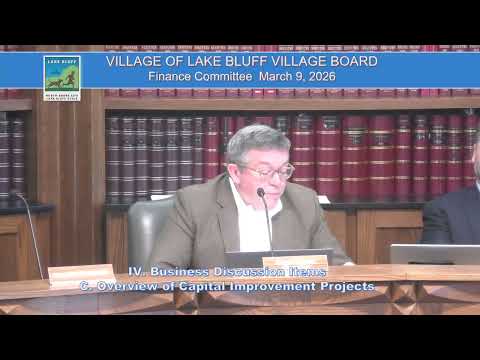
Bettina, presenting staff’s high-level overview, told the Finance Committee the village’s proposed FY2027–28 biennial general fund and capital plan anticipates a roughly 3.4% increase in operational expenditures and targeted use of reserves to support major infrastructure investments. "We're reviewing the fiscal year 2027-2028 biennial general fund and capital project overview," she said, and confirmed the public process includes a hearing on April 13 and final adoption targeted for May 1 as required by law.
The presentation outlined revenue assumptions: property-tax growth driven by CPI adjustments and new construction; projected sales-tax growth of about 3%; and stronger-than-expected state income-tax distributions, although staff noted a possible small reduction referenced by the governor. On the expense side, Bettina said the village anticipates higher costs for police and fire insurance, staffing, and equipment, and that the board plans to transfer money from reserves to capital, vehicle replacement and stormwater funds.
Staff projected reserves would decline from roughly 92% to about 51% by the end of 2028 under the current capital program and transfer strategy. "Because of the major infrastructure investments, we're projecting reserves to decline from 92% to 51% by the end of 2028," Bettina said, noting the village uses a biennial approach that allows planning across two years.
Project priorities staff highlighted include water-system work, sanitary improvements, roads and bridges, stormwater infrastructure, and facility upgrades at Village Hall, Public Works and Public Safety. Staff also listed smaller community projects such as train-station repairs, secure bicycle racks and gazebo rehabilitation (the gazebo is a bicentennial gift that requires masonry and stair repairs), and proposed a Village Green public Wi‑Fi option with an implementation estimate near $10,000.
On stormwater, staff described the master plan’s scale and trade-offs for sequencing long transmission mains versus smaller local projects. Jeff, who walked the committee through the capital summary and priority rankings, said the full master solution for the study quadrant could be on the order of $11 million. "I think it's $11 million worth of work at once," he said, adding that staff expects to pursue smaller, staged projects—one near-term project staff estimated could be done for less than $3 million—to address the most severe household‑flooding hot spots first.
Staff stressed the village will pursue federal and state grant opportunities to accelerate construction and noted project sequencing must account for larger transmission work (e.g., IDOT timelines and railroad permitting) to avoid installing improvements that would later be undone. Committee members pressed for clearer public communication about what each project stage will do for residents and asked staff to publish the detailed facility and project spreadsheets included in the packet.
The committee agreed to revisit a previously designed bike-path lighting project; staff will update costs and assess whether lighting should proceed ahead of adjacent stormwater work. Bettina said department worksheets began in December and reiterated the April 13 public hearing and May 1 adoption targets.
The committee did not take formal budget action at the meeting; staff said they will return with updated costs and a recommendation to the village board after the March 30 follow-up meeting.