Get Full Government Meeting Transcripts, Videos, & Alerts Forever!
Get email alerts on the Lbyc Boat Storage topic
No spam. Unsubscribe anytime.
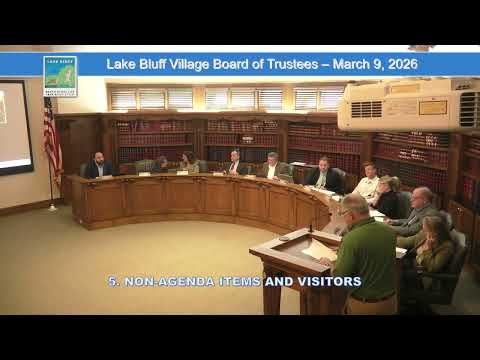
Lake Bluff board approves revised Yacht Club boat-storage plan, sends fence details back to architects board
Summary
The Village Board approved first-reading amendments to the Lake Bluff Yacht Club’s boat-storage plan at Sunrise Beach and directed the Architectural Board of Review to finalize fence materials, paint and landscaping; trustees debated visibility, wind loads and plant survival before voting to approve the plan and refer final aesthetics to the ABR.
The Lake Bluff Village Board on March 9 approved first reading of a revised development plan for a boat-storage compound proposed by the Lake Bluff Yacht Club at 503 Sunrise Avenue and instructed the Architectural Board of Review to finalize fence materials, trim color and landscaping.
The plan, revised after public workshops, reduces the size and height of a proposed boathouse compared with the 2024 approval and adds a six‑foot fence, landscaping of tall native grasses and three goose‑neck building lights. Planning staff noted the Plan Commission/Zoning Board of Appeals (PCZBA) recommended a six‑foot opaque (board‑on‑board) fence, while the Architectural Board of Review (ABR) preferred an open‑style iron/picket fence with landscape screening.
Trustees spent the bulk of a lengthy discussion weighing the PCZBA’s aesthetic and privacy concerns against ABR counsel about wind loads and plant survival in sandy shoreline soils. “The ABR reviewed an open style with landscaping and felt comfortable if the plantings were grouped rather than placed in an even line,” a village planner told the board; an ABR representative and yacht‑club speakers explained that wind and a subsurface tank restrict how deep posts can be set, which in some places limits the viability of a fully opaque wood fence.
Several trustees said they wanted the higher‑quality fence material extended to the north gate and to be symmetrical on the south side near the picnic shelter; the board likewise asked the ABR to confirm that selected plantings (the packet showed a tall sand‑loving grass) would thrive in the limited rooting area near the curb.
During public comment, resident George Russell urged the board to avoid chain‑link fencing and to require the nicer fence type along the north side back to the gate, noting only 18 inches of soil may be available for any plant screening.
After debate, the board approved the ordinance on first reading by voice vote, then approved a motion to waive second reading and adopt the ordinance subject to ministerial edits. The board’s motion specified that the ABR would return final decisions on trim color and whether the fence is an open picket/iron style with landscape screening or an opaque board condition; the board preserved the PCZBA’s recommended fence extent (to the rear of the south beach shelter on the south side and to the north gate on the north side) while leaving material and color to ABR final review. The roll call to waive second reading recorded one abstention and otherwise carried.
The village staff said ABR review of the two fine points would not slow construction; the yacht club agreed to return to ABR for the final aesthetic details. The board also asked staff to flag constraints for plantings (limited soil, wind exposure) so ABR’s decision would reflect site realities. The item concluded with the board resuming the regular meeting order.
What's next: The yacht club will work with ABR on final fence material, paint and planting arrangements; construction can proceed following ABR sign‑off and any required permits.