Get Full Government Meeting Transcripts, Videos, & Alerts Forever!
Get email alerts on the Drones topic
No spam. Unsubscribe anytime.
Sunflower Labs demos autonomous security drone; committee probes privacy, law‑enforcement access and costs
Summary
Jeff Dickerson of Sunflower Labs demonstrated an autonomous 'beehive' drone system with on‑device blurring and a nationwide BVLOS FAA waiver. Committee members asked about privacy controls, data ownership, jamming resilience, operating costs and how law enforcement would access footage; the presenter said client owns the data and can host it in its cloud bucket.
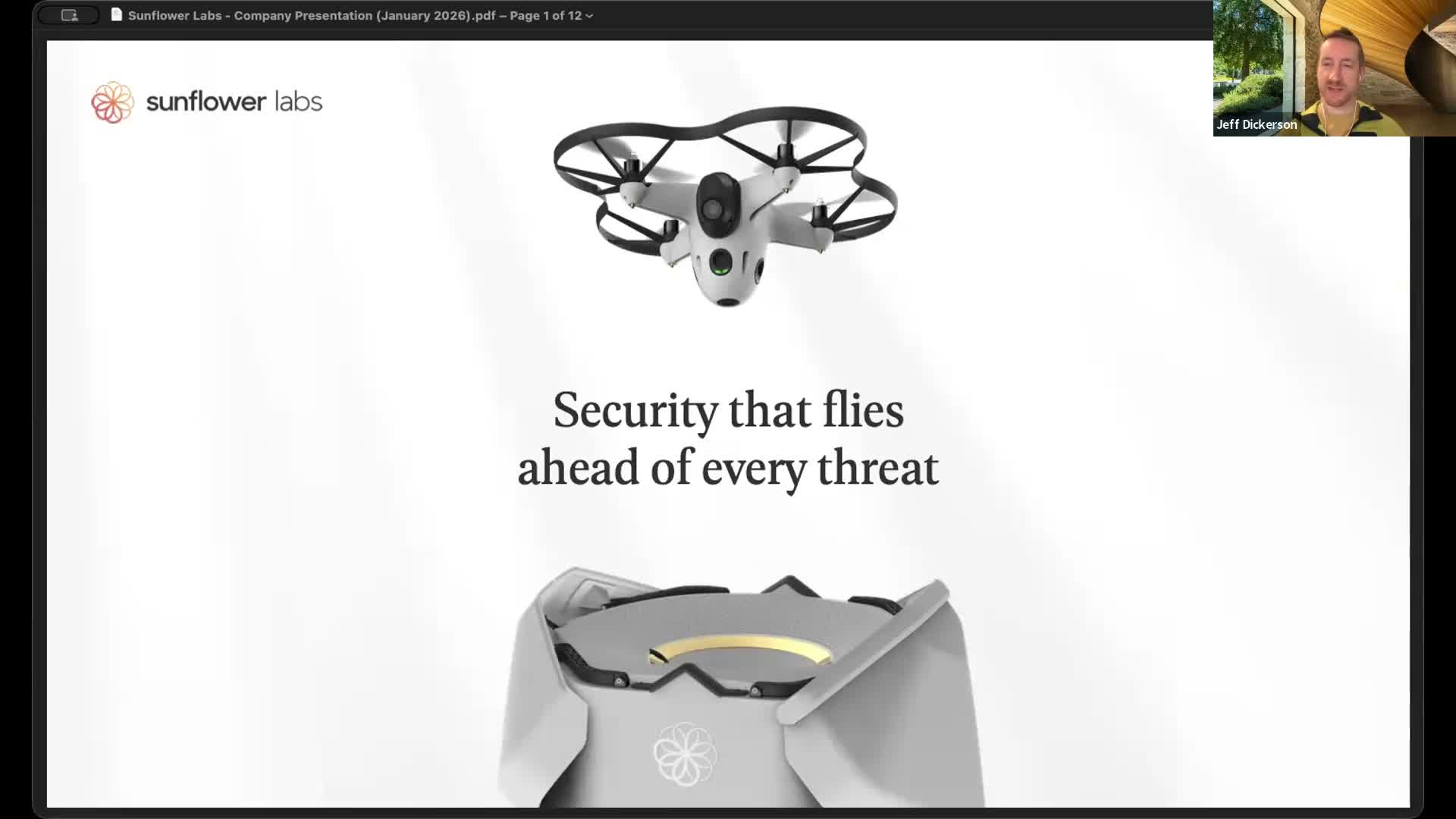
The Technology Committee received a detailed demonstration from Sunflower Labs, where Jeff Dickerson, who identified himself as head of sales, showed an autonomous drone system designed for property and neighborhood security. He demonstrated a live mission, explained an opt‑in/opt‑out blurring feature that hides private property by default, and said the company holds an FAA BVLOS waiver that allows the system’s intended autonomous operations.
Dickerson said the system is typically rooftop‑mounted, blurs non‑opted‑in properties by default and can stream footage to a client‑controlled cloud bucket; customers may restrict Sunflower’s access so that the vendor has no direct access to stored video. The presenter described safety testing (hundreds of thousands of flights) and contended the system’s design and data support secured approvals. He also stated customers can encrypt their bucket with their own key.
Committee members pressed on operational details: typical patrol altitude (30–50 feet), maximum per‑flight time (about 15 minutes) and per‑day flight caps (company limit reported as 9 hours). Members asked how the system handles RF jamming and GPS interference; the presenter acknowledged those risks but said frequency hopping, band shaping and return‑to‑home behavior reduce that exposure. Attendees asked how the system would integrate with local law enforcement; the presenter said footage can be provided to police only with client permission, and recommended streaming into an RTCC for police consumption.
Cost questions drew scrutiny. The presenter gave an example pricing model described as hardware‑as‑a‑service: roughly $5–$6 per hour (vendor provided illustrative daily and annual figures). Committee members calculated that continuous 24/7 coverage at an illustrative $5.50/hour would equate to roughly $48,000 a year for a single unit; the presenter said customers commonly treat the service as a recurring managed offering and that deployments are site‑customized.
Concerns about vandalism, physical tampering and the need for rooftop mounting were raised; the vendor said common deployments place the base station out of easy reach and pairing with fixed cameras that detect rooftop tampering can automatically launch a response. No procurement vote was taken; the committee will continue dialog with the fire district and staff about appropriate pilot roles, privacy safeguards and potential joint deployments.