Get Full Government Meeting Transcripts, Videos, & Alerts Forever!
Get email alerts on the Surveillance Oversight topic
No spam. Unsubscribe anytime.
Urbana Human Rights Commission to back oversight of surveillance technology but not take investigatory role
Summary
The Urbana Human Rights Commission voted to draft a statement for City Council supporting civilian oversight of surveillance technologies but declined to be named in the ordinance, saying its current complaint process and the Civilian Police Review Board (CPRB) are better suited for investigatory work.
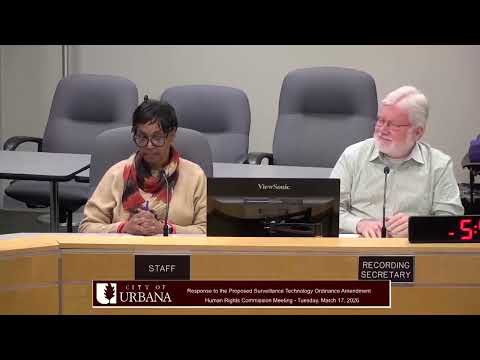
The Urbana Human Rights Commission voted March 17 to draft a statement for the City Council saying it supports civilian oversight of surveillance technology but does not need to be listed in the proposed ordinance as an investigatory body.
The motion, approved by voice vote, directs staff to prepare a concise statement for the commission to submit to the council in time for the April 6 meeting. The commission’s action follows a city request that both the Civilian Police Review Board and the Human Rights Commission serve in an oversight capacity for complaints about police-owned surveillance tools such as drones, portable cameras and vehicle alarms.
The commission’s chair said the group “support[s] the idea of oversight and we wouldn’t mind being in an advisory position,” but added the commission did not want to take on case-level investigative duties or be the final arbiter on evidentiary matters. Commissioners noted an existing internal complaint pathway (the “1222G complaint process”) and said complaints about city employees would generally be referred to the Illinois Department of Human Rights (IDHR) rather than be investigated internally by the commission.
Members raised practical questions about workload and timing — for example, how often the commission would be asked to meet, whether it would need to review video or reports, and whether a named role in the ordinance would create ongoing responsibilities. To avoid imposing new investigatory duties while signaling support for oversight, the commission agreed a supportive statement that emphasizes an advisory/referral role was the appropriate response to the city’s draft.
City staff and commissioners reiterated that the surveillance language under consideration is a draft amendment to existing ordinance language and has not yet been adopted. The commission’s statement will be finalized and transmitted to the City Council prior to the April 6 council agenda deadline.
What’s next: Staff will draft the statement and circulate it to commissioners for edits; the commission scheduled no additional vote beyond the approval to draft and submit the statement.