Get Full Government Meeting Transcripts, Videos, & Alerts Forever!
Get email alerts on the Outbreak Status topic
No spam. Unsubscribe anytime.
Maine Forest Service: recent forest tent caterpillar activity centered in Big 6 Township; aerial spray and monitoring options reviewed
Summary
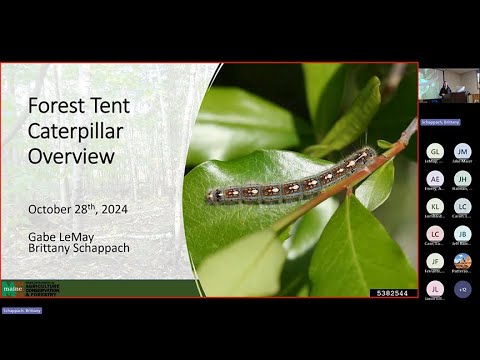
State and regional experts told a workshop audience that a new focus of forest tent caterpillar (FTC) defoliation was identified near the Quebec border in Big 6 Township (3,385 acres mapped in 2024) and reviewed monitoring and management options — including egg-mass surveys, pheromone trapping and possible Btk aerial applications timed to early larval emergence.
A Maine Forest Service workshop on forest tent caterpillar (FTC) on [date] brought state and regional specialists together to lay out where the insect is active, how landowners can monitor for risk and what management choices exist.
Bridal Shapak, an entomologist with the Maine Forest Service, opened the session with an ecological overview of the insect. She emphasized that FTC is a native, cyclical species that typically causes defoliation but does not kill healthy trees outright; outbreaks tend to peak every 10–15 years and last two to four years, though trees already stressed by drought or other factors are at higher risk of long‑term damage.
Gabe Lemay, an entomologist with the Maine Forest Service, presented the agency’s recent surveillance. He said light-trap and aerial/ground surveys show a modest uptick in moth captures and defoliation in northern/sortheastern Maine. "This year we logged 3,385 acres of damage, primarily in Big 6 Township," Lemay said, and he noted Quebec Forest Service data show contiguous infestation across the international border.
Speakers described monitoring tools landowners can use. Pheromone/kill‑cup traps and long‑running light‑trap networks provide broad detection; egg‑mass surveys give the stand‑level assessment that most directly predicts next season’s defoliation. The recommended egg‑mass method: sample the upper third of dominant sugar maple crowns, inspect selected branch tips for spumalene‑encased egg masses, repeat across trees and plots, and consult standard protocol reference tables (New York, Vermont and Alberta methods were cited).
The workshop also reviewed management options if a landowner decides to treat. The only active ingredient discussed for aerial application was Bacillus thuringiensis subspecies kurstaki (Btk), described as an ingestible larvicide that must be applied when larvae are small and leaves are present (roughly late April into May). Btk’s environmental persistence was described as brief — on the order of 3–5 days — so timing matters. Presenters explained operational considerations: droplet calibration and characterization, effective vs total swath planning, aircraft type tradeoffs (fixed‑wing vs rotary), operator licensing and regulatory notifications. Two applicators were named during discussion.
Panelists emphasized that aerial survey polygons are useful for situational awareness but not a substitute for ground‑based egg‑mass surveys and that applicators should not rely on Forest Service polygons for spray blocks. State pesticide officials also reminded attendees that applicators must follow label instructions and state notification requirements; attendees were advised to consult licensed applicators for per‑acre cost and concentration details.
The session concluded with guidance for landowners who want to prepare for a possible treatment year: set up or check trap networks, run egg‑mass surveys on stands of concern, coordinate phenology monitoring with applicators for timing, and check product availability (some BT products may be scarce seasonally). The Maine Board of Pesticides Control posted additional application and notification guidance on its website, the panel said.
Next steps: field egg‑mass survey training at Big 6 Township the day after the workshop and follow‑up surveys this winter to track egg‑mass abundance and predict potential defoliation in the coming season.