Get Full Government Meeting Transcripts, Videos, & Alerts Forever!
Get email alerts on the Dda Budget topic
No spam. Unsubscribe anytime.
Lawmakers, families and providers clash over Maryland DDA budget cuts as analysts warn of risks to waiver, services and workforce
Summary
At a Health and Human Services Subcommittee hearing, DLS analysts and Maryland Department of Health officials outlined the fiscal 2027 DDA budget and proposed cost-containment measures; families, providers and advocates urged rejection of wage cuts, a $500,000 individual cap and reductions to dedicated hours, saying the proposals would destabilize services and raise human and fiscal costs.
Victoria Martinez of the Department of Legislative Services opened the hearing for the Health and Human Services Subcommittee with a detailed budget review of the Maryland Developmental Disabilities Administration (DDA), saying the fiscal 2027 allowance reflects a $542 million (14%) reduction from the prior working appropriation and that DLS recommends restricting certain funds pending reports on utilization, person-centered-plan (PCP) processing times and cost-containment implementation.
Dr. Mina Sichani, MarylandDepartment of Health secretary, told senators the departmentregards the FY2027 proposal as a "measured" package intended to preserve waiver approval and long-term sustainability while protecting services for Marylanders with intellectual and developmental disabilities. She said the administration is engaging stakeholders and that advanced payments to providers have largely been recouped.
The hearing then shifted into sustained question-and-answer about the budget drivers: DLS and the department attributed much of recent spending growth to the statewide transition to the LTSS (long-term services and supports) billing system and to higher utilization in two service areas—personal supports under the self-direction model and dedicated hours in the provider-managed residential model. DLS flagged a fiscal 2025 shortfall and other prior-year deficiencies that contributed to the current fiscal picture.
Committee members pressed MDH on key proposals that have drawn public concern: aligning the reasonable-and-customary wage standard in the self-directed model to Bureau of Labor Statistics data; eliminating the wage-exception process that allows families to pay above-standard rates to retain staff; implementing a $500,000 cap on individual PCP budgets; and policy changes to dedicated hours that DDA estimates will yield savings. MDH said it supports DLSrequests for additional reporting and described a multidisciplinary exceptions review team and ongoing recruitment work to fill critical positions.
Public testimony filled the afternoon. Housing advocates urged continued funding for rent-supplement and housing supports to enable community living. Families and self-directed participants described how individualized supports prevented repeated hospitalizations and maintained stability, and they warned that proposed wage cuts and caps would force experienced direct support professionals (DSPs) out of the field and put medically fragile people at risk.
"The proposed DDA budget cuts aren't just numbers on a spreadsheet. They're a direct threat to my family's survival and Nathan's stability," said Christine Got, a direct support professional who testified about a projected 30% pay cut to self-directed staffing in some proposals.
Several parent and provider witnesses described denials and delays for PCP approvals, including cases in which families received late notice of plan changes that would reduce staff pay or hours. Shaina Farlo, a nurse and legal guardian, said DDA denied a plan for her brother on the basis of paperwork she characterized as an administrative duplication and called the outcome discriminatory toward families using a particular nursing care vendor.
Provider organizations and statewide disability advocates—the Maryland Association of Community Services, the Maryland Developmental Disabilities Council, The Arc/Ark Maryland and others—urged the subcommittee to reject or rework the governor's proposals, arguing that the administration's savings estimates undercount the likely fiscal impact on the provider network and that unintended consequences could increase rather than reduce total state spending by triggering hospitalizations, institutional placements or loss of federal matching funds.
Speakers recommended alternatives and safeguards, including modest across-the-board rate adjustments rather than targeted wage rollbacks, stronger efforts to enroll eligible participants in Medicaid waivers to capture federal match, clearer transition timelines for plan revisions, restored or clarified language for the day-to-day administrator function in self-direction, and equity investments such as sustained cultural-navigator programs.
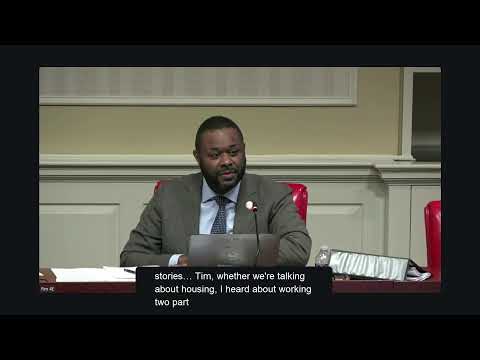
The hearing closed with committee leaders acknowledging the stakes and the complexity of balancing the state budget while preserving community-based supports. Senator Jennings and Senator Zucker thanked witnesses and said they would continue working with MDH and stakeholders. No formal vote was taken; DLS said it would process letters and recommended narratives and the department indicated concurrence with several DLS reporting requests. The subcommittee signaled continued engagement in follow-up meetings.
The most immediate procedural takeaway is that DLS recommended adoption of narrative language and conditional release of withheld funds pending reports; the department generally concurred, and members asked MDH to provide more granular recruitment and vacancy data, PCP-processing timelines, and an implementation plan for any cost-containment actions.