Get Full Government Meeting Transcripts, Videos, & Alerts Forever!
Get email alerts on the Active Transportation topic
No spam. Unsubscribe anytime.
San Carlos presents three midterm options to improve bike and pedestrian safety at US 101–Holly Street interchange
Summary
City of San Carlos consultants presented three midterm alternatives to improve bicycle and pedestrian safety where Holly Street crosses US 101, estimating $3–4 million for the fastest option and $6–8 million for protected designs, and warned Caltrans approvals could extend some options by several years.
City of San Carlos staff and project consultants outlined three midterm design alternatives on July 17, 2025, intended to improve bicycle and pedestrian crossings where Holly Street passes over U.S. 101 and to accelerate safety upgrades that were delayed while long-term plans awaited Caltrans work.
Ma, a consultant for WSP who is leading community outreach on the project, introduced the study area and timeline. Allison Mills of Tool Design Group, the lead engineering firm, summarized three options and the trade-offs among speed of implementation, user protection and regulatory approvals.
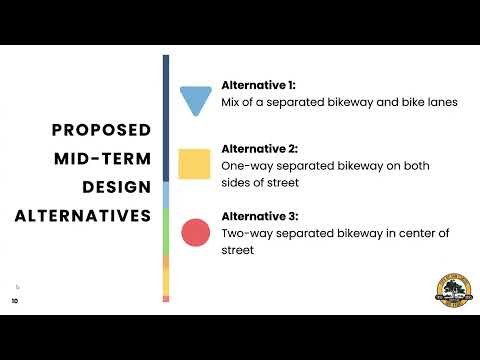
The first, quickest-to-implement alternative would add flashing beacons at on- and off-ramps, some concrete refuge islands and a mix of separated bikeways and standard bike lanes in constrained locations. "We anticipate that the entire process would take about a year and a half to two years," Mills said, estimating costs at roughly $3 million to $4 million. That approach would improve crossings sooner but would leave some bike lanes north of Shoreway Road without physical protection.
The second alternative would provide protected, separated bikeways for the full project length by converting a vehicle lane north of Shoreway Road and installing traffic signals at the U.S. 101 off-ramps rather than flashing beacons. Mills warned the lane reduction could increase congestion and that the additional signalization would raise costs and approval time: "including bike and traffic signals will extend the Caltrans approval process by two to three years," she said. Cost estimates for alternatives two and three were presented at about $6 million to $8 million.
The third alternative proposes a center-running, two-way separated bikeway between Industrial Road and Shoreway with bike signals to allow cyclists to transition on and off the center facility; north of Shoreway the bikeway would revert to standard curbside separated segments. Mills said adding concrete barriers to protect a center-running facility would require detailed structural analysis of the Holly Street bridge and could extend Caltrans review "up to four years."
Presenters emphasized jurisdictional constraints: the Holly Street overcrossing is owned and maintained by the California Department of Transportation (Caltrans), so any option that adds weight or changes bridge loading will require additional structural review and longer approval timelines. The study area spans San Carlos, the Caltrans-owned overcrossing, and the Redwood Shores side of Holly Street, so the project depends on coordination among multiple agencies.
Staff said short-term changes already completed include additional signage and high-visibility crosswalks installed in July 2025. The city plans final design for the selected midterm alternative to begin in 2026 and said it is preparing grant applications to fund midterm and long-term projects. If a funding application to the San Mateo County Transportation Authority (SMCTA) succeeds, award decisions could come as early as December 2025.
The project team asked residents to weigh in through an online survey and interactive map; the survey and map will remain open until July 31, 2025. Ma encouraged participation, saying, "your voice matters and we want to hear from you." The city will seek feedback from the Planning and Transportation Commission in August 2025 and expects staff to present a preferred alternative to the City Council in summer or fall 2025.
The meeting closed with contact information for city staff who can answer questions and provide updates on the project.