Get Full Government Meeting Transcripts, Videos, & Alerts Forever!
Get email alerts on the Land Use Variance topic
No spam. Unsubscribe anytime.
Land use commission narrowly recommends approval of Emerson Street development despite neighbors’ objections
Summary
The Evanston Land Use Commission voted 3–2 on March 25, 2020 to recommend approval of a major-variation request for 1103–1105 Emerson Street that would raise on-site units from the 12 permitted by right to 24 (30 with bonus units). Neighbors and Ebenezer AME Church urged upholding zoning or attaching strict conditions to protect sunlight, parking, stormwater and neighborhood character.
The Evanston Land Use Commission on March 25, 2020 voted 3–2 to recommend approval to city council of a major-variation application for 1103–1105 Emerson Street that would increase the site’s residential capacity well above the 12 units currently allowed by the R-6 zoning.
The motion, moved and seconded during deliberations, applied the staff-recommended packet of conditions with edits made on the dais. Commissioners Deborah Berlin and Harris Fary voted yes; Commissioner Johnson and Commissioner Mabati voted no; Commissioner Lynwall voted yes. The recommendation will go to city council for final action.
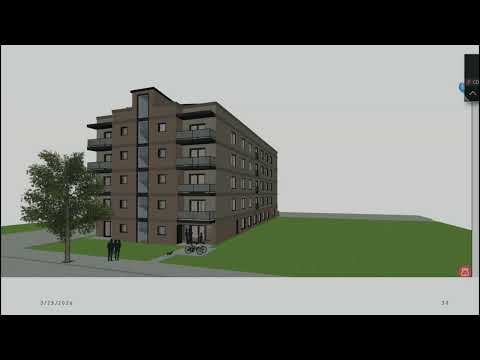
The proposal, brought by the property owners and their attorney, seeks 24 units on paper and would allow up to 30 units when bonus/inclusionary units are counted. The applicant said the project would include three on-site inclusionary housing units at 40% area median income and that higher unit counts are financially necessary to keep rents below other nearby new developments.
Opponents — including nearby homeowner Tina Peyton and representatives of the adjacent Ebenezer African Methodist Episcopal Church — told the commission they oppose the variances or want strong conditions. Peyton, who said her family has owned property on the block since 1915, described repeated sewage backups and property damage she attributes to nearby development and said the proposed five-story building would cast “a shadow the whole day” over her yard. “We’re the only Black house left on the block,” Peyton said, and urged commissioners to allow only as-of-right development (12 units).
Reverend Mitchell Smith, speaking for Ebenezer AME Church, said the congregation prefers that zoning limits be upheld but focused his remarks on minimizing practical harm if the project proceeds. The church asked the commission to require clear protections for alley operations, move-in and trash handling, limits on amplified sound and lighting, effective stormwater controls, preconstruction documentation of church property, and a local property-management contact to resolve operational problems.
Attorney Melissa Clotsz, representing the applicant, told the commission the project team had tried to reach neighbors and the church, that the developers are willing to continue meetings with the church, and that some concerns (for example, required stormwater detention and trash enclosure screening) are already addressed in staff materials. Clotsz clarified that the application requests 24 units on paper (with bonus units making the practical maximum 30) and said the team is aiming to keep rents roughly 20–30% below the area’s newest luxury projects by offering smaller, furnished units.
Commissioners’ deliberations reflected a split. Opponents on the commission argued the proposed unit count is far above precedent for the district and warned of precedent-setting effects and the mismatch between the lot and the proposed density. Supporters pointed to the inclusionary units, the need for family-sized units in the housing supply, and the practical availability of off-site leased parking. Several commissioners stressed the importance of enforceable conditions addressing construction impacts and long-term operations.
Key conditions discussed and incorporated into the recommended approval package included: leasing of off-site parking stalls to ensure a minimum number of tenant-available off-street spaces (commissioners debated whether the minimum should be five or six stalls), prohibition on tenants obtaining on-street residential parking permits near the site, limits on impervious surface consistent with code, installation of a screened trash enclosure if trash is stored outside, a required construction management plan that addresses hours, staging, contractor parking, vibration monitoring and neighbor communications, preconstruction property surveys, compliance with the inclusionary housing ordinance (three on-site IHO units), and a requirement that the applicant meet with the neighboring church prior to submission of the construction management plan and continue to meet on an ongoing basis to mitigate issues during construction and occupancy.
Commissioners and staff also discussed a pending state law change that would eliminate local off-street parking minimums; staff noted the law is scheduled to take effect in June but that entitlements granted now would stand for this project if approved. Several commissioners said that legal change complicates future precedent-setting and that any approval should emphasize enforceable operational conditions.
The commission’s recommendation does not authorize construction. It forwards the major-variation application and the commission’s conditions to Evanston City Council, which will take the final vote. The commission also recorded requests for additional follow-up: the applicant to provide executed parking-lease documentation prior to certificate of occupancy if the council imposes that condition, and for staff to ensure the construction management plan is reviewed by relevant departments and shared with the church for comment prior to permit issuance.
The commission closed the public hearing and will return the matter to city council; the Land Use Commission’s next meeting was announced for April 22.