Get Full Government Meeting Transcripts, Videos, & Alerts Forever!
Get email alerts on the Planning Design Information Exchange topic
No spam. Unsubscribe anytime.
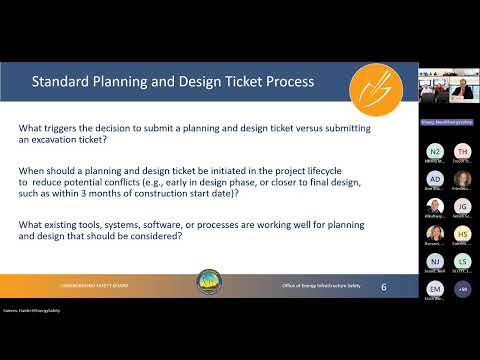
Underground Safety Board hears industry push for maps-first, two-step planning/design inquiry and multi-week response windows
Summary
Stakeholders at the Underground Safety Board workshop broadly supported a formal planning-and-design information exchange under Government Code 4216.1B that provides GIS maps during design and, where needed, field verification later. Participants recommended 30–45 day map response windows for many projects, urged risk-tied standards rather than mandatory depth reporting, and warned of ticket-abuse and data-liability risks.
The Underground Safety Board convened a stakeholder workshop to gather input on rules for exchanging planning-and-design information under Government Code 4216.1B, the board’s staff said. The board must adopt implementing regulations by July 1, 2027.
Design engineers, utilities, contractors and call-center operators said the planning-and-design inquiry should be an information-exchange distinct from excavation tickets: the consensus favored a two-step approach — maps and records first, then field verification (paint marks or potholing) later as required. "If I'm trying to design a new pipeline, I need to know what's there before I go and dig," said Jimmy Griggs, a civil engineer with the Sonoma County Water Agency, urging early access to verified field data to avoid construction conflicts and higher taxpayer costs.
Why it matters: Participants said better, earlier utility information reduces unknowns during construction, lowers strike risk and can shorten schedules and cost overruns. But utilities stressed practical limits: many record sets are incomplete, depth data are often not available for aging facilities, and some responses require NDAs or fees.
Response-time expectations: Several engineers and contractors said 30 days is often workable; AT&T representatives said providing detailed maps can take longer and recommended up to 45 days for full map packages, with an earlier receipt/acknowledgement. PG&E and SoCal Gas described current practice: PG&E said a two-business-week turnaround after NDA in many cases, while SoCal Gas estimated roughly 30 days depending on request scope and workload.
Scope and standards: Industry groups urged that requirements be tied to project risk or size rather than apply to every routine maintenance job. Several participants recommended adopting Subsurface Utility Engineering (SUE) and ASCE quality levels where justified but cautioned about cost and practicality early in design. Multiple speakers noted legal limits under existing law — including that Government Code 4216 currently excludes depth markings — and said regulations should reflect those constraints.
Who pays and how to prevent abuse: Contractors and designers argued owners or project teams should fund detailed SUE or data requests for commercial design work. Several utility representatives noted current map responses are often provided without charge but suggested fees or minimums for large or complex requests. Multiple attendees raised ticket-abuse concerns — repeated or bid-driven requests that overwhelm locators — and urged procedural guardrails, better inquiry identifiers, and enforcement options.
Data quality and longer-term goals: Stakeholders encouraged adopting technologies to capture field-located coordinates (GPS-enabled locating, smart-pigging where applicable) and to feed validated points into GIS for reuse. Call-center and utility speakers warned that standards, quality control and liability protections will be needed before widespread reliance on historic maps or third-party datasets.
Board direction and next steps: Staff said input from the workshop will inform regulatory drafting and that a public survey is expected in early March 2026. The board is aiming to balance safety, practicality and cost when defining timelines, minimum data requirements and any fees or limits on the planning-and-design exchange.
The workshop concluded with an invitation for written comments and the promise staff will incorporate the feedback into the board’s rulemaking process.