Get Full Government Meeting Transcripts, Videos, & Alerts Forever!
Get email alerts on the Hotel Occupancy Tax Grants topic
No spam. Unsubscribe anytime.
Alpine tourism director details who can apply for hotel-occupancy-tax grants and sets April 17 deadline
Summary
City tourism director Chris Rian outlined what the hotel-occupancy-tax grants will and will not pay for, stressing that Alpine must spend at least half its collections on advertising, that infrastructure is ineligible and that complete applications must be received by 5 p.m. April 17.
Chris Rian, director of tourism for the city of Alpine, on Thursday walked through the city’s hotel-occupancy-tax grant program, explaining eligible expenses, caps and the application process and urging organizers to pair event funding requests with advertising plans to show they can attract overnight visitors.
The grants are governed by state law, Rian said, and the city council, as the collecting and expending entity, must comply with that law though it may add stricter rules. "The purpose of these grants is basically defined by the state law that created that tax," Rian said. He added that the city is required to spend at least half of the money it collects on advertising, a requirement that shapes what the committee typically funds.
Why it matters: The program exists to increase overnight stays and local lodging revenue. That focus determines what the city can pay for — advertising, promotion of the arts, historic restoration/preservation, sporting events and limited transportation — and excludes capital improvements such as upgrades to playing fields or other infrastructure.
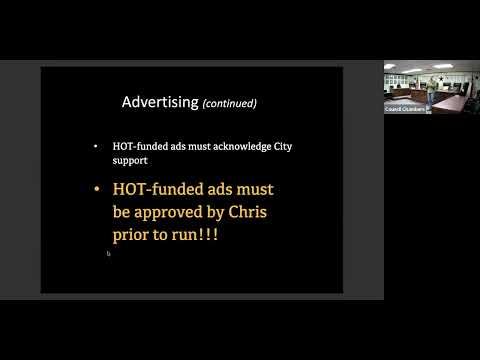
Rian gave details applicants will need to plan for. Advertising must target audiences outside the immediate local area (the city uses a roughly 75-mile window and a tri-county market for planning). Allowable ad buys include television, radio, digital ads and newspapers that demonstrably reach out-of-area readers; production and design costs are capped (Rian said 15% of ad money may go to production) so most of a grant’s ad allocation must be spent on placement. Local publications can be prorated if they provide verifiable circulation data showing an out-of-area audience.
Historic and arts requests carry their own limits: promotion of the arts is a common use for live-music events but the fund’s policy generally limits arts spending to 15% of annual receipts; historic projects are eligible when they have a clear, documented connection to local history (for example, interpretive signage on city property). Sporting events can qualify when a majority of attendees are tourists, but "infrastructure" — such as stadium or field upgrades — cannot be paid for from the grant fund, Rian said.
The city’s fiscal year runs Oct. 1–Sept. 30; the funds discussed are for Oct. 1, 2026–Sept. 30, 2027. Rian warned organizers that events scheduled near the fiscal-year boundary may need separate grant work and explained how advertising often must be paid and planned in a different fiscal year than artist or vendor fees.
All application materials must be received by the city secretary by 5:00 p.m. Friday, April 17; Rian emphasized that "received" means the materials must be in the city secretary’s inbox or hands by the deadline, not merely postmarked. Required attachments include a proposed event budget showing revenue sources, a marketing plan, an estimated attendance/economic-impact statement and, for previously funded events, an event report with photos.
The review process has two parts: staff checks applications for completeness and compiles required attachments; the committee scores each application (impact on overnight hotel stays is weighted most heavily, followed by professionalism, capacity to host and promote, and revenue diversity) and then meets a second night to allocate limited funds and work budgets. Rian said committee members may give extra credit for new or innovative events and may fund strategically even when scores are low.
Rian offered practical tips to strengthen applications: include sample ads for pre-approval, work with partner hotels for discount codes or room blocks that can demonstrate overnight stays, collect zip-code samples from attendees or otherwise document out-of-area attendance, and be realistic about how much of an event’s revenue the grant would cover.
Rian also invited applicants to consult with staff during planning and said the application and current guidelines are available on the City of Alpine website under the "How do I" menu at the "Hotel occupancy tax grants" page; he gave his contact information at the meeting for questions and for a sample marketing plan. The city will post the sample materials and applicants may contact Rian for help with advertising calculations or local-media prorating.
Next steps: organizers should assemble the required attachments and submit completed applications by 5:00 p.m. on April 17; the tourism office will screen for completeness before an initial scoring meeting and a subsequent allocation session.