Get Full Government Meeting Transcripts, Videos, & Alerts Forever!
Get email alerts on the Short Term Rentals topic
No spam. Unsubscribe anytime.
Saratoga council directs staff to prepare ordinance banning short‑term rentals after residents cite noise, safety and parking problems
Summary
Following lengthy public comment and staff analysis, the council voted 4–1 to direct staff to draft an ordinance explicitly prohibiting short‑term rentals and outlining enforcement and fines; staff estimated $60,000–$80,000 gross revenue but cautioned enforcement may require vendor contracts and staff time.
Saratoga — After sustained public testimony describing loud parties, blocked driveways and safety concerns on narrow private streets, the Saratoga City Council on Jan. 21 directed staff to prepare an ordinance explicitly prohibiting short‑term rentals (STRs), voting 4–1 with Councilmember Aftab opposed.
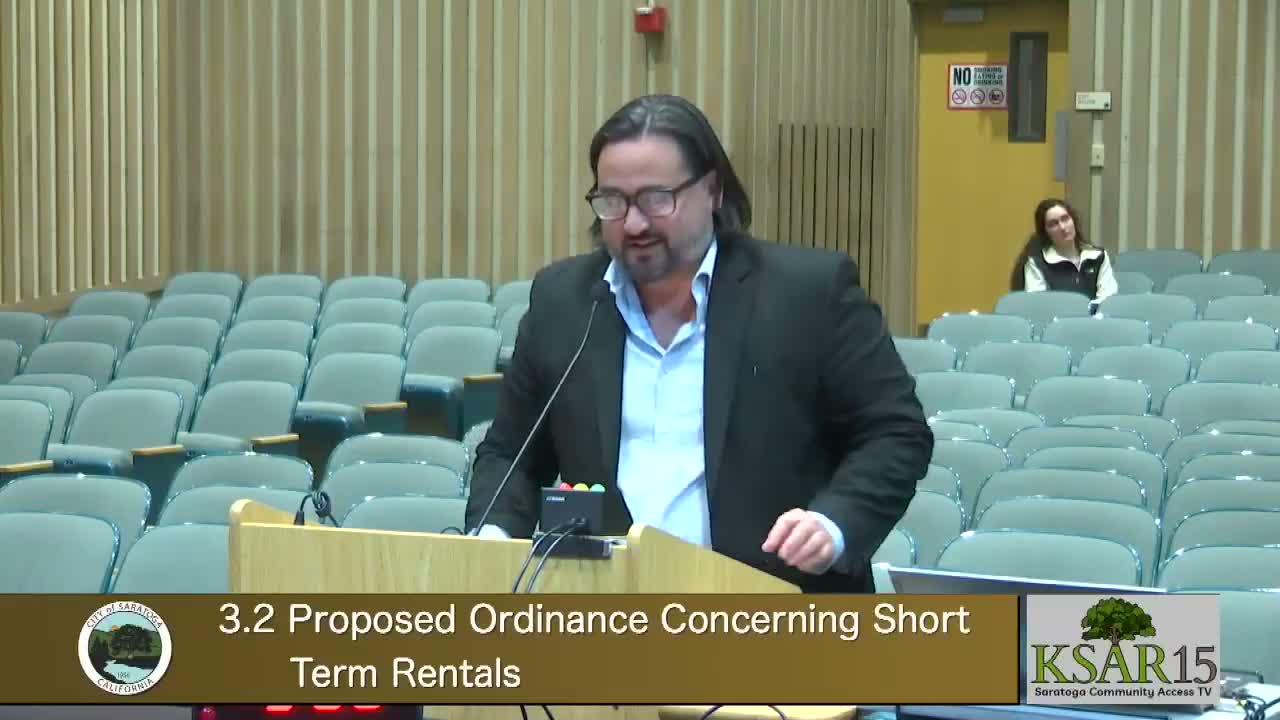
Community Development Director Brian Swanson told the council staff had forwarded two options from the planning commission: make the current implicit prohibition explicit with robust enforcement and fines, or adopt a regulatory framework permitting licensed STRs with caps and performance rules. "Short term rental is a residential dwelling unit with a term of 30 days or less," Swanson said during his presentation, and he summarized the planning commission’s 6–1 recommendation to prohibit STRs and to request STR facilitator reports under state law.
Public comments were strongly opposed: residents who say they lived next to legal STRs recounted blocked driveways, 17‑car parties on small private streets and late‑night disturbances; several urged the council to preserve neighborhood safety and quality of life. A local hotel representative urged collection of transient occupancy taxes (TOT) to level the playing field.
Enforcement tradeoffs: Staff estimated potential gross TOT and licensing revenue at roughly $60,000–$80,000 annually but cautioned that effective enforcement is resource‑intensive. Swanson said a vendor that scans listing platforms could cost about $5,000–$10,000 per year and that in‑house code enforcement time would be substantial; staff estimated net revenue might be about half of gross after enforcement costs. The city attorney warned that without third‑party data or STR facilitator reports enforcement is difficult and labor‑intensive.
Council action: After deliberation, Councilmember Zhao moved to direct staff to prepare an ordinance explicitly prohibiting short‑term rentals, including enforcement language and fines (the desk attachment suggested fines of $1,500 for a first violation, $3,000 for a second, and $5,000 for further violations within a year). The motion passed 4–1, with Councilmember Aftab voting no.
What happens next: Staff will draft the prohibition ordinance and return it to the council for review; the council discussed collecting unpaid TOT and civil penalties if violations are discovered. The city will also evaluate vendor options for proactive listing monitoring and the workload needed for enforcement and collections.