Get Full Government Meeting Transcripts, Videos, & Alerts Forever!
Get email alerts on the Climate Action Plan topic
No spam. Unsubscribe anytime.
Staff says Saratoga is on track for 2030 emissions goal but urges caution on assumptions
Summary
Staff reported the city is projected to exceed its 2030 greenhouse‑gas reduction target (46% below 1990 levels) under current state and regional assumptions but warned results rely heavily on EV adoption, electricity decarbonization and modeling assumptions; council pressed staff for methods and sensitivity details.
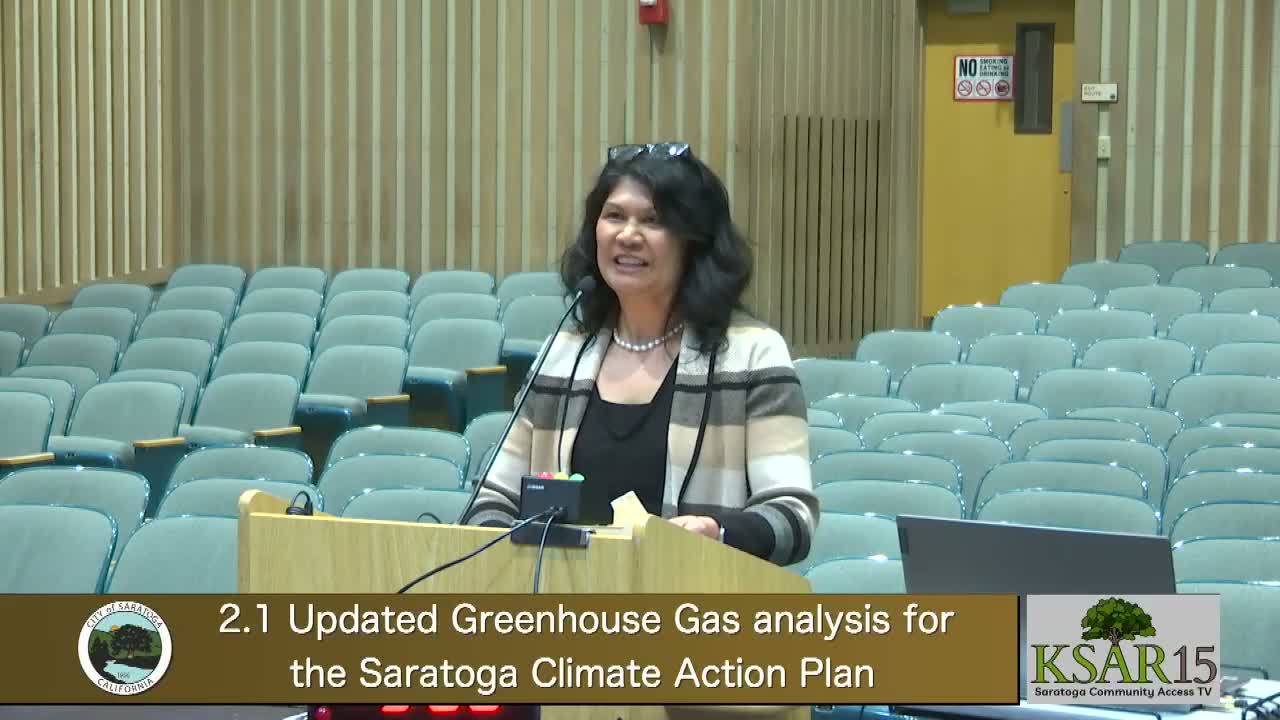
Saratoga staff presented an updated greenhouse‑gas analysis tied to the city’s Climate Action Plan and told the council its current forecast projects 2030 community emissions at about 86,564 metric tons CO2e — roughly 46% below 1990 levels, which would exceed the city's 40% reduction goal.
Mainini (staff) explained the update used Saratoga’s 2024 emissions inventory, revised growth assumptions, state regulatory projections and localized activity data (electricity consumption, vehicle miles traveled and natural‑gas use). The analysis applies emission factors from the California Air Resources Board and regional transportation modeling; quantified measure impacts (for example electrification of appliances, EV adoption, and state fleet regulations) were applied to produce the 2030 forecast. Staff noted the forecast includes a buffer of roughly 9,900 metric tons but also presented sensitivity scenarios showing that, if regional and state assumptions underperform by about 50%, the city could fall short of the 40% goal.
Council members asked for clarity on how projected new housing and density assumptions reduce vehicle miles traveled (VMT) given Saratoga's limited job centers. Staff (including Christina O’Rourke, online) said the modeling assumed some new units near transit and West Valley College, that high‑density and affordable housing assumptions qualify for reduced VMT under Bay Area methodologies, and that new units were modeled as electric‑ready under reach codes. Staff also described inventory methods (activity data multiplied by emission factors) and noted they revise past inventories to maintain apples‑to‑apples comparisons.
Council discussed the role of EV market incentives and acknowledged national-quarter sales fluctuations; staff said recent quarterly sales in Santa Clara County remained strong despite federal tax-credit changes and that the analysis includes buffer assumptions. Council members asked whether local actions (e.g., stricter reach codes, tree planting, municipal fleet electrification and more public chargers) could be directed to reduce reliance on regional assumptions; staff said council could direct such local measures to reduce risk.
No formal council action was taken on the Climate Action Plan analysis at the meeting; staff concluded by offering to provide further detail and underlying calculations for council review.