Get Full Government Meeting Transcripts, Videos, & Alerts Forever!
Get email alerts on the Housing topic
No spam. Unsubscribe anytime.
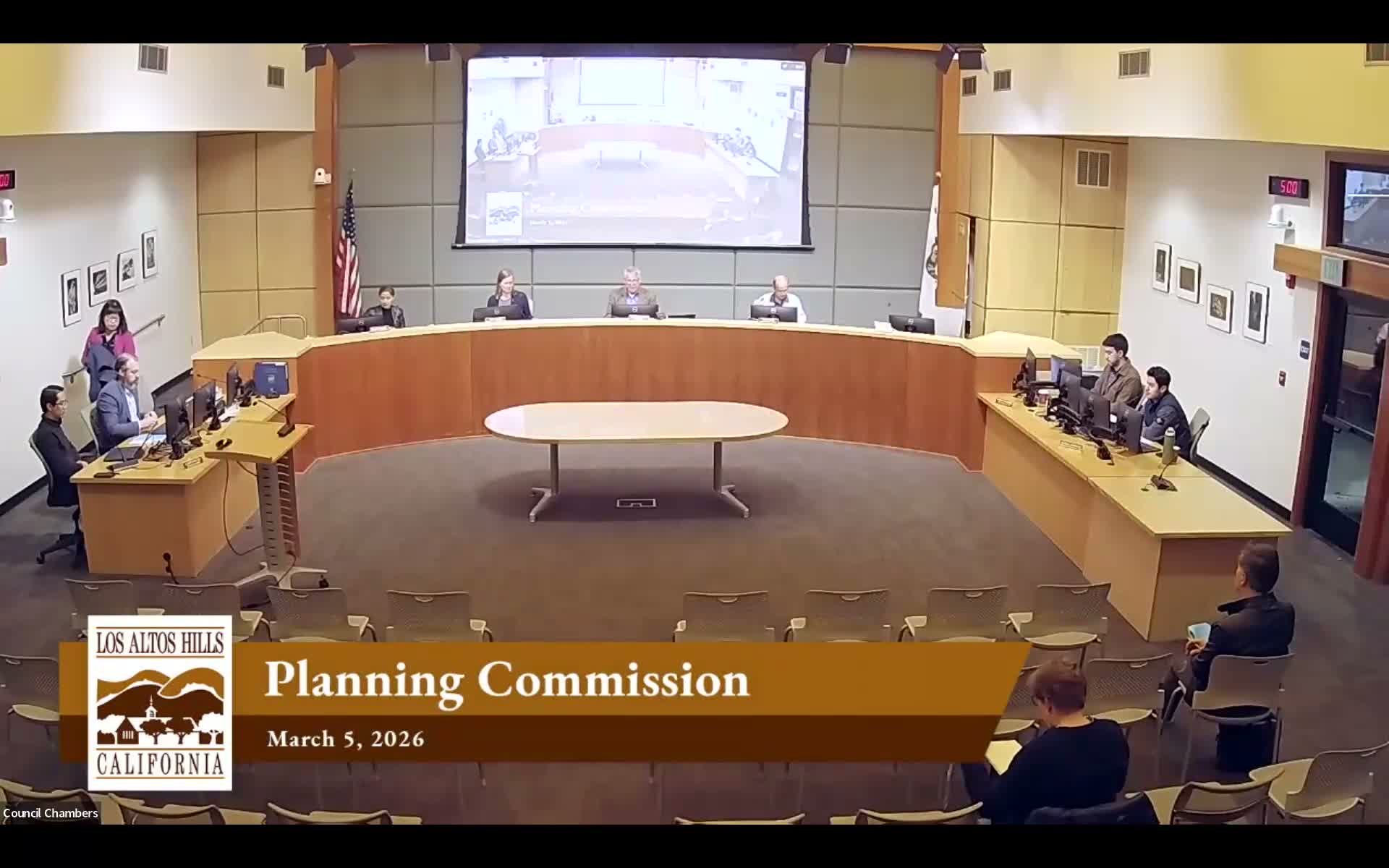
Planning commission recommends ADU ordinance updates to council; lengthy SB 9 debate signals further policy work
Summary
Commission voted to recommend staff's ADU ordinance amendments to the City Council to conform with state ADU law, while commissioners engaged in an extended discussion about SB 9, incentives, and how to preserve front setback protections as higher‑capacity electrical service and ADU rules change.
The Los Altos Hills Planning Commission on March 5 voted to recommend a package of technical updates to the town’s accessory dwelling unit (ADU) ordinance to the City Council, while reserving larger policy questions — such as objective design standards and how to align multifamily and SB 9 rules — for further study and public engagement.
Staff explained the recommended changes are primarily to bring the municipal code into compliance with state law. The draft ordinance clarifies definitions for primary dwelling units and livable‑space conversions, updates ADU allowances in a newly created multifamily zone, adjusts sprinkler and sewer‑connection rules for state‑exempt ADUs (detached conversions under 800 square feet and 16 feet in height), and formalizes timelines and written notice practices for denials.
"This ordinance does serve to bring the town's current municipal code fully into compliance with current state law," staff said during the presentation.
Commissioners supported completing the state‑required technical updates but emphasized the commission must still address outstanding local policy questions — including maximum ADU sizes, whether ADU design should be required to match the primary residence, and how to make objective design standards timely and visible to the public. Several commissioners pressed staff to reconvene the ADU ad hoc committee and return quickly with prioritized, publicized questions for community input.
Separately, staff presented a broad discussion of California Senate Bill 9 (SB 9) and Senate Bill 450 (SB 450) implications. Under SB 450, SB 9 development standards must align with the underlying RA (single‑family) zone; the planning staff outlined several options to reconcile that requirement with the commission’s desire to preserve front setbacks and neighborhood character. Options included a tiered approach that limits the size and height of structures within a 4–30 foot setback band, reserving a fixed floor‑area allowance ('credit') for SB 9 units that is deducted from the parcel’s MFA/MDA, or townwide reductions in MFA/MDA to force discretionary review for larger proposals.
Commissioner Patel urged staff to aim for quick, public work on objective design standards and proposed maintaining consistent 800‑square‑foot thresholds across ADU and SB 9 related allowances. "Let's put a stake in the ground," he said, asking staff to bring a plan back to commissioners for public input within weeks to months rather than deferring the debate indefinitely.
Public commenters asked for clearer public engagement; one resident said ad hoc committee outputs are not visible to the public and urged a more transparent process. Staff said it would take comments to HCD for clarification and return with options. The commission voted to recommend the draft ADU ordinance and errata to the City Council (attachment 1/2 and errata) by roll call vote.
Next steps: staff will meet with HCD, reconvene an ADU ad hoc, advertise workshops for public input, and bring more detailed proposals on objective design standards and SB 9 alignment for future hearings.