Get Full Government Meeting Transcripts, Videos, & Alerts Forever!
Get email alerts on the Entertainment Zone topic
No spam. Unsubscribe anytime.
Redwood City council approves ad hoc recommendation to pilot downtown entertainment zone
Summary
The council voted 5–0 to approve staff’s ad hoc recommendation to pilot a city‑activated entertainment zone on the Broadway pedestrian mall, allowing participating businesses to sell beer and wine for consumption inside a defined public space during limited activations; staff will return an ordinance for possible adoption May 11.
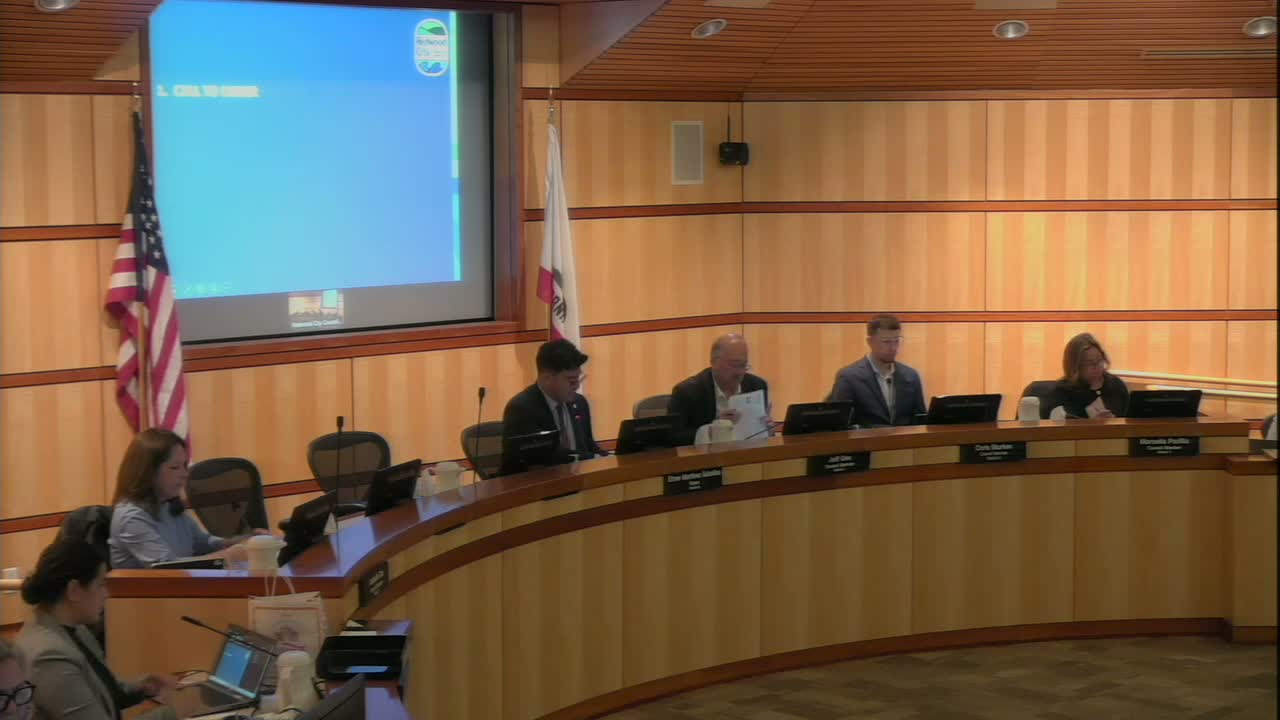
Redwood City’s council voted 5–0 on May 4 to approve an ad hoc committee’s recommendation to pilot an entertainment zone on the Broadway pedestrian mall, a controlled area where patrons could buy beer and wine from participating businesses and consume them in a defined public space during city‑activated events.
Deputy City Manager Jennifer Yamaguma, who presented the plan, told the council the tool is authorized by state law (staff cited “SB 9 69,” adopted in 2024) and would operate within ABC regulations and local rules on boundaries, hours and operations. Yamaguma described a phased pilot with 2–3 activations of two to three hours each over three to four months, active only when the city turns the zone on. She said the city would coordinate public safety, manage controlled entry/exit points and maintain emergency access.
"This is a controlled, flexible tool," Yamaguma said, adding the city would set activation hours within an allowable 10 a.m.‑10 p.m. window, require participating businesses to hold valid ABC licenses, and limit the initial launch to beer and wine.
The presentation included operational details: alcohol must be purchased from participating businesses and consumed inside the zone; containers must not be glass or metal; the ad hoc recommended no plastic and staff noted compostable or sugarcane cup options as possibilities. Staff estimated back‑of‑the‑napkin activation costs around $4,000–$5,000 per two‑hour activation (signage, barriers, public safety staffing, wristbands, cups), which would make the proposed pilot roughly $15,000–$20,000 in total.
Councilmembers voiced support while flagging implementation points. Councilmember Chu praised the initiative as an experiment to support downtown businesses and community activation. Councilmember Padilla said outdoor activation was a natural fit for warm months and could help eateries and nightlife businesses attract foot traffic. Councilmember Sterkin urged consideration of extending hours or allowing cocktails in the future if the pilot succeeds and suggested using volunteers to help with event staffing.
Councilmember Gee asked several operational questions, including confirmation that glass and metal are prohibited and whether the city would require rehearsed emergency plans. Yamaguma responded that security and emergency procedures would be part of the implementation guidelines and that staff would work with police and fire to plan and scale staffing based on the event.
The formal motion approved the ad hoc recommendation as revised by staff (including a minor cleanup to section 33 B 3 of the draft ordinance). Councilmember Sterkin moved and Councilmember Chu seconded the motion; the mayor requested an electronic vote and the motion passed 5–0 with Councilmember Howard and Vice Mayor Aiken absent. Staff said it would return the ordinance for adoption on May 11 if council chooses; staff indicated the ordinance, if adopted on May 11, would take effect in June.
The council asked staff to proceed with outreach to businesses and the public, finalize guidelines and consider marketing partnerships to educate patrons about zone boundaries and rules. Staff said it will monitor economic activity and public safety and report back with recommendations, and state law requires an evaluation at least every two years.
Council discussion and the staff presentation emphasized that the pilot is intentionally limited in scope and that the city will refine operations based on experience. The ordinance introduction and council approval of the ad hoc recommendation do not by themselves create an active entertainment zone; activation will be at the city manager’s discretion and only during announced events.