Get Full Government Meeting Transcripts, Videos, & Alerts Forever!
Get email alerts on the Renewable Energy Regulation topic
No spam. Unsubscribe anytime.
County counsel briefs Marathon supervisors on limits of local power and how JDAs, intervention can secure protections
Summary
Outside counsel told Marathon County supervisors that state law and the PSC limit local ordinances for projects over 100 MW, and advised early negotiation of joint development agreements, PSC intervention or other steps to secure decommissioning funds, road repairs and emergency-response training.
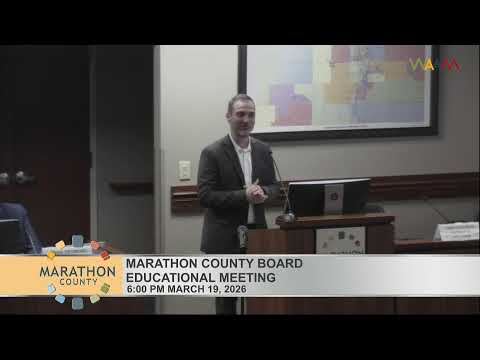
Marathon County supervisors spent much of the March 19 meeting on a detailed briefing from Atollis Law and the Wisconsin Counties Association about how the county can respond to proposed large-scale wind and solar projects.
The essentials. Counsel told the board that projects above a 100‑megawatt threshold generally trigger Wisconsin Public Service Commission (PSC) jurisdiction and a Certificate of Public Convenience and Necessity (CPCN), which limits the reach of local ordinances. Rebecca Roker (Atollis Law) explained that Wis. Stat. §66.0401 and case law (including Echert/Echert Brothers and the Town of Brighton litigation) tightly constrain local regulation and leave counties with a narrow set of police-power exceptions (health and safety, cost/efficiency impacts, or alternate comparable systems).
Why counties still negotiate. Counsel urged early engagement because, even when local zoning is preempted, counties can negotiate voluntary joint development agreements (JDAs) with developers to secure protections that PSC approvals may not impose. Typical JDA provisions identified by counsel include explicit liability protections for the county, financial assurances or trust funds for decommissioning, road‑use agreements and repair bonds, emergency-response training and payment for first‑responder resources, and limits on shadow flicker, setbacks and fencing.
Intervention and litigation. Counsel described intervention in a PSC proceeding as a way to become a formal party, introduce evidence, cross‑examine expert witnesses and build a record; that may be a necessary step if the county intends to challenge aspects of a CPCN decision. Litigation is expensive and often low-probability for stopping a project once a CPCN is approved, counsel said, so most counties combine negotiation and strategic intervention.
Local questions: JDAs, bankruptcy and batteries. Supervisors asked whether developers ever renege on JDAs and how to handle bankruptcy risk. Counsel recommended strong assignment clauses and non‑assignability without county consent, plus robust, segregated financial assurances to cover decommissioning and road damage should a developer fail. The panel also flagged the novel legal issues posed by standalone battery-energy-storage systems (BESS), which were not contemplated when many statutes were drafted and may allow more room for local regulation than large wind/solar facilities.
Next steps. Counsel recommended that the county prepare: an inventory of potential impacts (roads, emergency services, agricultural land, planning conflicts), an internal point person to lead JDA negotiations, and early outreach to affected towns so that joint positions and roles are clear. The board was told there is time to negotiate because no CPCN filings had yet appeared for the principal projects discussed.
(Reporting based on a presentation to the Marathon County Board of Supervisors by Atollis Law/WCA on March 19, 2026.)