Get Full Government Meeting Transcripts, Videos, & Alerts Forever!
Get email alerts on the Surveillance Technology topic
No spam. Unsubscribe anytime.
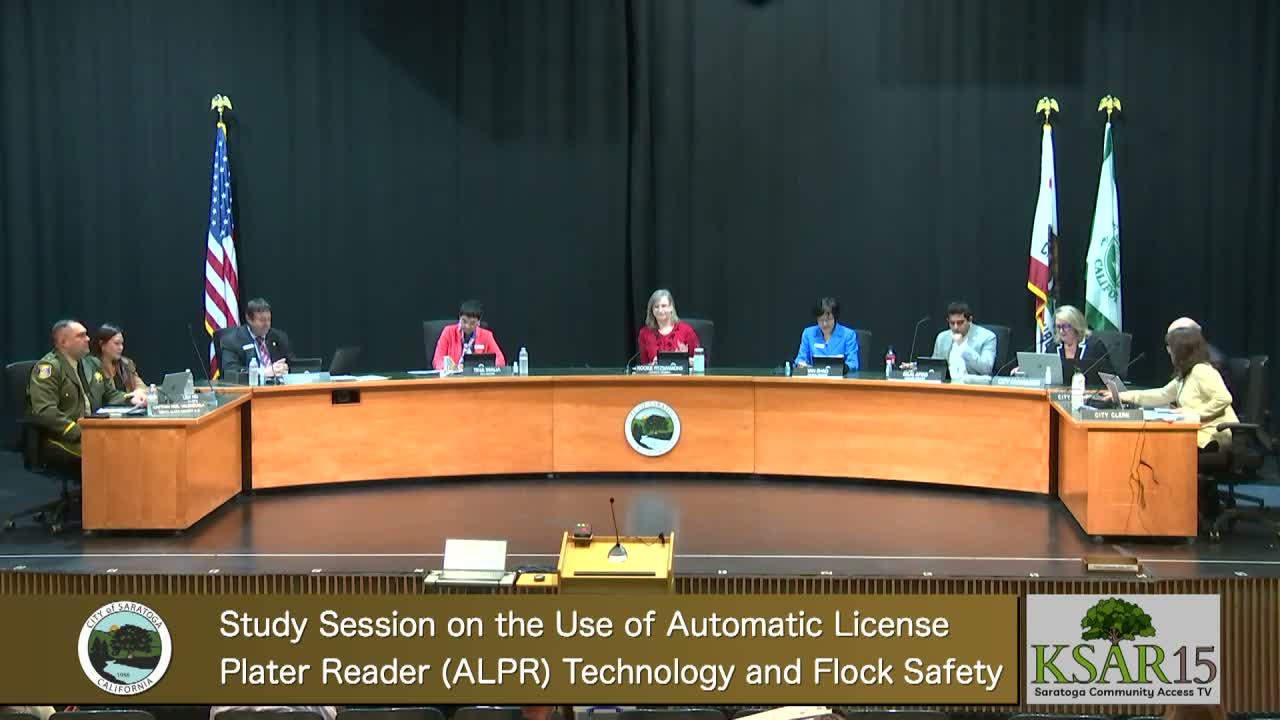
Saratoga study session exposes split over Flock Safety license-plate cameras after county blocks sheriff access
Summary
Council heard presentations from the acting city manager, the county sheriff's captain and Flock Safety about ALPR technology, privacy safeguards and recent county policy changes that prevent the sheriff from accessing camera data. Residents were sharply divided between neighborhood-funded safety supporters and privacy advocates; council made no decision and asked staff for follow-up.
Saratoga's city council held a study session focused on automatic license-plate readers (ALPRs) and the vendor Flock Safety, where officials and residents debated privacy risks, vendor practices and recent county policy changes that have left the sheriff temporarily unable to access camera data.
Acting city manager (speaker 2) told the council that Saratoga introduced ALPR in 2022 as a one-year pilot and has since expanded to 72 cameras, with 65 paid for by neighborhood assessment districts and seven funded by the general fund. He said the Santa Clara County Board of Supervisors recently amended its surveillance use policy; as a result, the sheriff's office cannot currently access data from the city's Flock cameras, although the cameras remain physically in place and neighborhoods continue to pay for the service.
Captain Neil Valenzuela of the Santa Clara County Sheriff's Office said the county's ALPR policy includes a 30-day rolling retention for plate images, frequent audits, training requirements and annual reporting to the Board of Supervisors. He described ALPR as a vehicle-focused investigative tool, not facial-recognition technology, and recounted cases where ALPR hits helped deputies locate stolen vehicles, apprehend suspects and recover stolen property. "We want to safeguard privacy and civil liberties at every step of the way," Valenzuela said, describing mandatory audits and supervisor approvals for hot-list entries.
Lily Hill, public affairs manager for Flock Safety, described the company's system design: pole-mounted cameras that capture images of a vehicle's rear, storage on AWS GovCloud, SOC 2 and ISO certifications, and a public transparency portal that lists prohibited uses and agency-sharing partners. Hill said Flock does not sell customer data and that customers retain ownership and control of their images. She also told the council that a very small subset ("less than 1%", by her account) of images is anonymized and used to train machine-learning models.
Council members and residents pressed both presenters on technical and policy issues: whether criminals can evade cameras (Valenzuela acknowledged plates can be removed or switched but said vehicle characteristics can still provide leads), how deletion after 30 days is implemented (Flock and the sheriff's office described a rolling scrub with permanent audit logs), and whether retained anonymized images can be reverse-engineered (Flock said it would check engineering's calculations and described the data as scrubbed).
The presentations also addressed a previously reported sharing incident: Valenzuela said a detective inadvertently allowed access to an out-of-state department (Houston PD) in a human-trafficking follow-up; county audit logs flagged the access, the county reported and rectified the error and then implemented an out-of-state toggle to prevent recurrence. Staff and law-enforcement witnesses said the county later paused broader interagency sharing after a 2024 review.
Public comment filled much of the meeting and sharply divided residents. Privacy advocates and immigrant-rights groups, including speakers who identified themselves as representing Silicon Valley Allied for the Common Good and others, urged removing Flock cameras or banning ALPRs citywide, citing audit logs showing searches by external agencies, concerns about data sharing with federal partners, historical examples of unauthorized access and the potential chilling effect on vulnerable residents. "We should remove these cameras," said Josh Williams, who identified himself as a technology industry security professional.
Neighborhood leaders and several off-duty deputies and residents who had funded cameras said the devices deter crime and have produced investigative leads. Multiple neighborhood-watch representatives said they voted to install cameras and pay for them through local assessments; several described solved cases and urged the council to press the Board of Supervisors to restore local access or to negotiate stronger vendor accountability and penalties.
Speakers requested more transparency on contract terms, the scope of audit logs, independent verification of Flock's claims about retained and anonymized data, and a clearer breakdown of how often ALPR data was used in Saratoga investigations and with what results. Council members asked staff to gather additional information, review neighboring cities' transparency portals and policies, and explore technical and legal options (including narrower search rules or warrant-driven searches for sensitive cases) before making policy changes.
No formal action was taken at the study session. The council concluded the meeting by thanking residents for a high-turnout public comment period, asking staff for follow-up reporting on technical safeguards, crime-data analysis and alternative vendor options, and adjourning to the regular council meeting at 7 p.m.
The staff presentations and public comments made clear that Saratoga faces a choice between honoring neighborhood-funded safety investments and responding to county and regional concerns about data security, third-party access, and the potential misuse of aggregated ALPR datasets.