Get Full Government Meeting Transcripts, Videos, & Alerts Forever!
Get email alerts on the Agriculture Nitrate Policy topic
No spam. Unsubscribe anytime.
State Water Board expert panel backs release of draft nitrate report amid debate over regional 'limits' vs. 'targets'
Summary
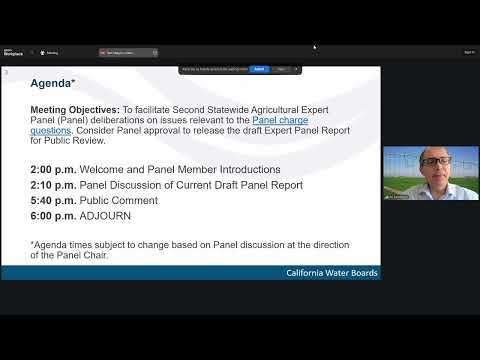
A statewide agricultural expert panel for the State Water Resources Control Board agreed to release a draft report for public comment but spent much of its March 11 meeting arguing over whether regional water boards should be urged to set enforceable interim nitrate limits or be left to adopt voluntary targets and outlier processes.
The State Water Resources Control Board’s statewide agricultural expert panel working group voted to move the draft agricultural nitrate recommendations out for public comment after a lengthy March 11 meeting, but panelists split over whether the report should recommend that regional boards set enforceable interim limits or allow voluntary targets coupled with technical assistance.
Panel Chair Daniel Gistler of UC Davis led a line‑by‑line review of the draft and asked members to flag language they wanted changed before the document is circulated. Analisa Kiara, assistant deputy director for the State Water Resources Control Board’s Division of Water Quality, told the panel the board would "participate in the public comment period to share any input we have for the panel to consider alongside all other comments received" and summarized the schedule: Chair Gistler will send a clean draft to board staff by March 13, dissenting opinions from panel members should be submitted by March 23 for insertion in Attachment E, and staff aim to release the public draft on or before March 30 for a 30‑day comment period.
Why it matters: the panel is advising the State Water Resources Control Board on how to address nitrate pollution from irrigated agriculture, a long‑standing threat to groundwater used for drinking. The central dispute at the meeting concerned whether the report should explicitly recommend that regional water boards may set enforceable interim discharge limits at the high end of measured values (for example, upper percentiles of A‑minus‑R metrics) or instead recommend that regions pursue targets, outlier identification, and step‑wise reductions supported by technical assistance.
Panelists argued both sides. Richard Smith, a retired vegetable crop adviser, and Michael Khan, an irrigation and water resources farm advisor, emphasized a phased approach: set initial, upper‑end limits where discharges are clearly excessive, and treat more stringent step‑down objectives as targets supported by substantial technical assistance and innovation. "As you go down to more restrictive objectives, that's when the growers are going to need more technical assistance," Richard Smith said, arguing that technical help and technology adoption are necessary for growers to meet tighter restrictions.
Other panelists, including Thomas Harter (UC Davis), urged caution about prescribing limits statewide. Harter said the panel should avoid language that reads as a mandate and instead provide flexibility for regional boards — noting legal, economic and agronomic considerations vary by basin. He repeatedly pushed for clarifying the draft so it states that regional boards "may" set limits and that whether a given metric is written as a limit or a target should be decided regionally.
Region‑specific discussion factored heavily. Panel members reviewed Region 3 (Central Coast) and Region 5 (Central Valley) approaches: Region 3 had proposed numeric values in an existing order (discussed as "Order 4.0" in the meeting), while Region 5 staff and coalitions have developed township‑level targets and an outlier identification process with periodic (five‑year) reviews. Several panelists said regionally tailored processes and review schedules can provide both accountability and flexibility.
Data and feasibility: the panel repeatedly returned to agronomic feasibility and data transparency. Members debated whether an example numeric value that appeared in the draft (500 pounds nitrogen per acre) should remain or instead be reframed as "achievable in some crops or areas" because feasibility varies by crop, soil, and irrigation. Panelists also discussed the role of models (e.g., SWAT), discount factors for organic amendments, mineralization, and the need for clearer documentation on how growers and coalitions calculate applied and available nitrogen.
Research and monitoring recommendations: the panel recommended more integrated research sites that link crop and soil measurements to groundwater monitoring wells, better study of irrigation water nitrogen contributions and uptake, and clearer guidance on how non‑fertilizer sources and mineralization should be treated in reporting and modeling.
Outcome and next steps: after editing the draft to clarify targets versus limits and to add guidance on agronomic feasibility and regional variation, the group recorded no objections when Chair Gistler asked whether anyone opposed releasing the draft for public comment. The report will be circulated to panel members and board staff for final edits; staff expect the public comment period to run roughly March 30–April 30 with a staff‑led public hearing in early April. Panelists were told dissenting opinions submitted by March 23 will be appended to Attachment E of the released draft.
What to watch: public commenters at the meeting urged the panel to recommend mandatory interim limits rather than optional ones, arguing voluntary targets have failed to protect drinking water. The panel's framing of limits versus targets — and how strongly that framing is worded in the public draft — will shape the board's rulemaking and how regional boards implement controls or assistance programs.